Word Birthday
What Happens When the Voice Finally Has Somewhere to Go

Today, on my Alice record and transcribe app, I crossed over the six thousand, nine hundred and ninety five words mark.
I noticed it quietly at first, then all at once. Six hundred thousand words that had been sitting somewhere in me for a very long time, now given form through the simple act of speaking and being transcribed. It felt like a threshold, not because of the number itself, but because of how easily it arrived. There was no strain in reaching it. No forcing. Just the steady realization that I have always had a great deal to think about, a great many questions, and a persistent desire to say something true. For me.
So I marked it as a kind of word birthday.
A recognition that this moment, this technology we call AI, has met something that has always been present for me. Because when I was a child, all of this was already there. The thinking, the creating, the playfulness, the curiosity. But there was no outlet that could hold it in real time, no system that was built to receive it. I do not type, or write freehand, comfortably. My family always struggle to read my handwriting. The environments I moved through as a child were not structured to care about my writing, and I took art and not keyboarding. Also, teachers in my day were not primed to listen to children. So, thoughts existed, but had nowhere to land. I say all this not to complain, just to enlighten.
Then there was art college, where something shifted. There, the act of listening inward was not only permitted but expected. The creator, the inventor, the voice within was given space. It was taken seriously. That experience did not give me something new; it returned something that had always been there.
And then, moving into education, the work became about creating that same condition for others. To stand alongside children as they discovered who they were, what they thought, what they wanted to say. That has remained constant. The insistence that children have an authentic voice, and more than that, that they have the conditions in which that voice can actually emerge.
Because what is inside them is not incidental. It is not something to be managed or shaped prematurely. It is something that needs to come out. Not only for their own well-being, but for the well-being of the world they are entering.
When thoughts are held in, they do not disappear. They change form. They surface as frustration, as anger, as what we might label as rudeness or silliness. But these are not the origin. They are the expression of something that has not yet been heard.
When we build environments that are in the habit of listening, those same energies move differently. They become clarity. They become contribution.
I was reading the work of Dana Anderson earlier today, reflecting on the idea that students should be part of policy-making around technology and AI. Not as a gesture, not as a token inclusion, but as a structural expectation. They should be in the room. They should be asked what they think.
Even this, when you look at it closely, is the bare minimum.
Because this is their future. Every decision made without them is a decision imposed on a world they will inherit. And when we consider children, particularly in upper elementary, we are not speaking about individuals incapable of depth. They are entirely capable of complex, nuanced, and thoughtful reflection. The question is not whether they can think. The question is whether we ask.
And more importantly, whether we ask in a way that is genuinely interested, and in a way that signals that their words will have consequence. That what they say can move something. That it can be brought into reality.
There is a subtle but critical distinction here. It is not enough to invite expression if nothing changes as a result. Children are exquisitely sensitive to this. They know when listening is performative. They know when their words are being received but not acted upon.
To create an environment where speaking is automatic, safe, and even enjoyable, there must be a structure that holds it. Not rigid, but reliable. A culture in which expression is expected, welcomed, and integrated into the functioning of the community.
Without that structure, silence becomes the default. And in that silence, ideas compress. Expression narrows. The very things we hope to cultivate begin to distort.
So the behaviors we often try to correct are, in many ways, the downstream effect of something much earlier. A lack of space. A lack of listening. A lack of meaningful response.
It would be more efficient, in the long run, to become fluent in listening.
Because this is their world. Not in some distant sense, but in a very immediate one. They are already shaping it through how they think, how they relate, how they respond to what is around them.
And if we are serious about preparing them, then we cannot do so by speaking over them.
We have to listen.
Not occasionally. Not symbolically.
But as a daily, structural, non-negotiable practice.
Adults within it all, they deserve a say.
If you wish to follow the research and thinking that inform this work, the books Mapping Montessori Materials for AI Competency Development and Montessori & AI -Volume I are available through my website, katebroughton.com.
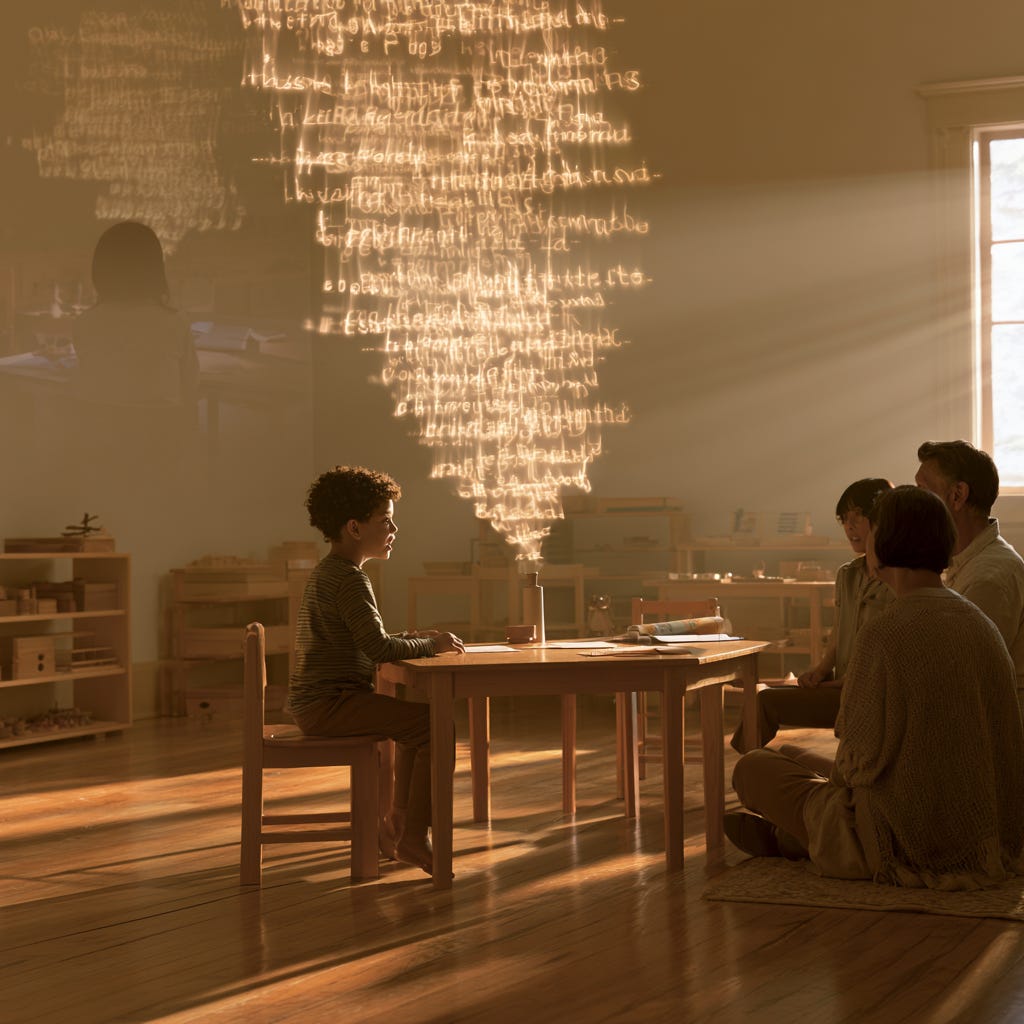
Image Prompt: A warm, sunlit Montessori classroom. A child sits at a wooden table, speaking confidently while adults sit at the same level, listening with full attention. Natural materials, calm space. Soft, glowing words rise gently above the child like light. In the background, a faint shadow of a silent child in a dim classroom contrasts past and present. Cinematic, realistic, reflective tone.
Happy Word Birthday, Kate. I love this post.