The Slope Ahead
Conversation, Disagreement, and Educational Responsibility

There is a slope coming out of the park where I am right now and it is making me put in a little extra effort as I walk upward. The slope itself is not difficult, but further ahead I can see that the road rises much more steeply. If I continue, there is every chance that by the top I will be slightly out of breath.
And I have a choice.
I can continue on the flat ground where everything feels predictable and easy, or I can begin walking toward the incline. Every day, in one form or another, that is the truth of human life. Do we remain where things are comfortable, where our thinking is uninterrupted and our assumptions stay intact, or do we willingly place ourselves in situations that require effort, adjustment, uncertainty, and reflection?
At the top of the hill there may be a better view. There may be photographs worth taking. There may be the simple feeling that the effort itself mattered, that the body worked, that the lungs expanded, that something was strengthened through the climb. The challenge is not only about arrival. Often it is the process of exertion itself that changes us.
I think about this often in relation to children and education because so much of meaningful learning is really an invitation into manageable discomfort. Good educators do this constantly. They create conditions where children are asked to stretch slightly beyond certainty, slightly beyond memorization, slightly beyond automatic response. Sometimes this happens physically through movement, sport, practical work, or experimentation. Sometimes it happens intellectually through discussion, ambiguity, disagreement, or reflection.
Social studies classrooms have always had the potential to do this particularly well because the entire discipline is built around context, perspective, interpretation, and human complexity. A thoughtful educator poses a question and then gives genuine time for students to process it, debate it, write about it, or sit with it internally before responding. Sometimes students are even asked to defend a position they do not personally hold, not as manipulation, but as an exercise in perspective taking and intellectual flexibility. The point is not ideological conformity. The point is learning how thought itself operates when placed under gentle pressure.
Every time we provoke real thinking in children, their minds strengthen. Every time we ask them to consider nuance, contradiction, or another person’s perspective, we are helping build neural pathways that support reasoning, discernment, and emotional regulation. This does not mean placing children into unsafe or developmentally inappropriate political conflict. It means allowing classrooms to become places where the world can be discussed honestly and proportionally, according to age and readiness.
Young children already notice what is happening around them. They observe relationships, fairness, tone, exclusion, kindness, fear, tension, and contradiction long before adults imagine they do. The question is not whether children are perceiving these things. The question is whether we are helping them develop the language and emotional capacity to navigate what they perceive.
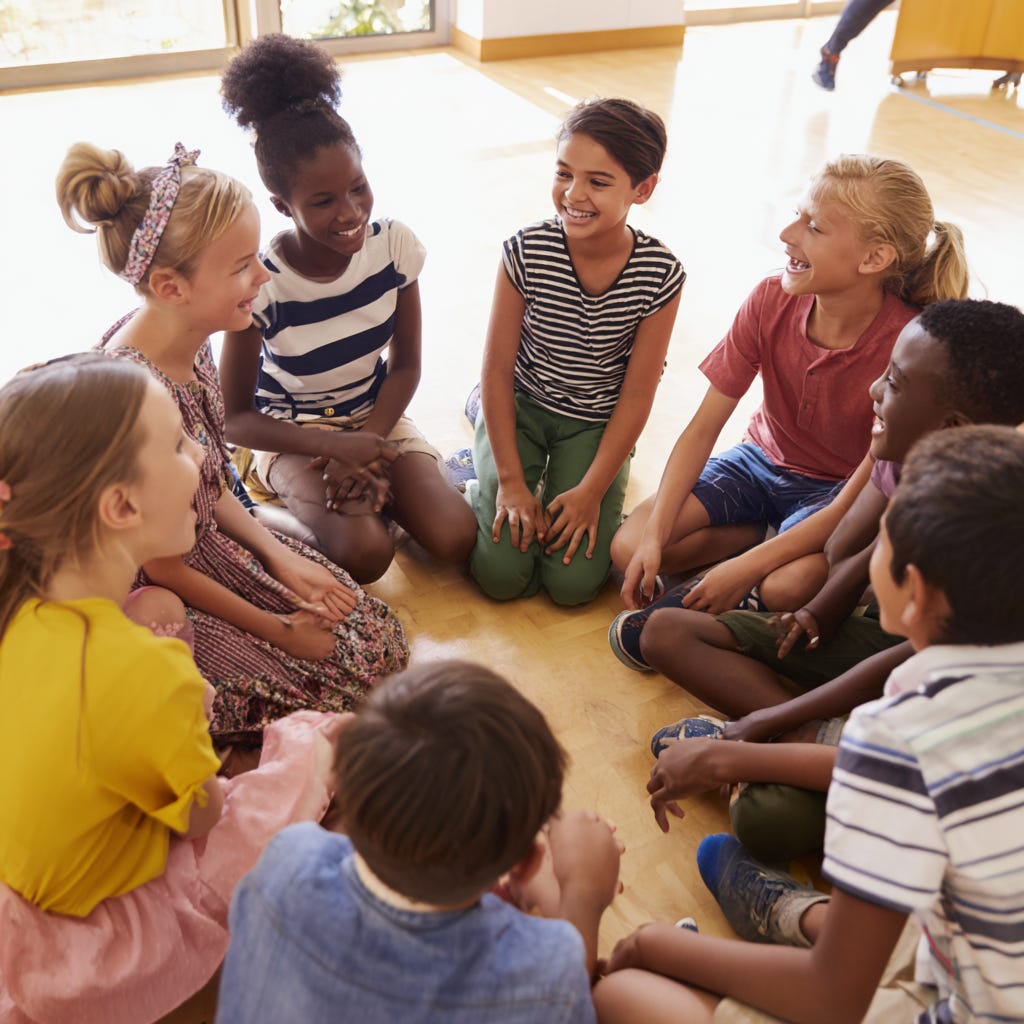
In Montessori environments this work has always existed quietly beneath the surface of the classroom. Morning meetings, peace tables, classroom circles, collaborative problem solving, conflict mediation, waiting for one’s turn to speak, learning how to disagree respectfully, learning how to listen without immediate interruption, learning how to express discomfort without aggression, these are not secondary features of education. They are foundational human capacities.
A child learns that another person may hold a different opinion and yet the relationship does not collapse. A child learns that disagreement is survivable. A child learns that discomfort can be spoken rather than suppressed. A child learns that resolution is not always necessary for respect to remain intact.
These are not gifts people are simply born with. They are skills. They are muscles developed through repeated experience.
If children do not encounter these forms of conversation within family life, then schools become even more important. Increasingly, particularly with the expansion of public pre-K environments, schools are becoming one of the primary places where human beings learn how to exist alongside differing perspectives without fragmentation or hostility.
This work can no longer be treated as optional enrichment or as a soft addition to the “real curriculum.” In many ways, it may now be the curriculum.
And this also requires something difficult from educators themselves.
If an educator cannot participate in respectful discussion, cannot tolerate disagreement, cannot regulate emotional responses during difficult conversations, or cannot distinguish guidance from ideological control, then children have very little chance of learning these capacities themselves. Education cannot ask children to develop conversational maturity that the surrounding adults have not practiced internally.
The responsibility is immense because children learn relational behavior far more through observation than instruction. They watch how adults respond when challenged. They watch tone. They watch pacing. They watch whether disagreement creates rupture or curiosity. They watch whether authority becomes defensive or remains steady.
The most important classroom in our school is the toddler environment because that is where these foundations were first being built. Very small children learning how to wait, how to listen, how to share space, how to tolerate frustration, how to express unhappiness safely, how to notice another person’s feelings, how to repair after conflict. These are extraordinary developmental achievements. Public schools do this work too, often quietly and without recognition, but the significance of it has changed.
What once felt supplementary now feels essential.
And then there is the strange irony of artificial intelligence entering all of this at precisely the same moment.
Artificial intelligence is built from us. Its systems are trained on enormous accumulations of human language, human patterns, human images, human preferences, human fears, human storytelling, human argument. AI is full of our words. It is full of our collective outputs, our tendencies, our habits of communication.
Which means that AI itself can become an extraordinary object of inquiry for children, not primarily as a shortcut tool, but as a research subject.
Imagine children placing the exact same prompt into three different AI systems: Write a story about a dog.
One system generates something whimsical and fantastical. Another produces something that feels emotionally realistic. A third creates something sensationalized, almost like a news headline. Suddenly the classroom conversation becomes fascinating.
What happened there?
Why did these systems respond differently? What kinds of human material were likely scraped, weighted, reinforced, or prioritized to produce these tones? What assumptions are embedded within the outputs? What patterns are visible? What biases emerge? What does this reveal about human culture itself?
That is a profound educational conversation.
The real opportunity right now is not speed. It is not productivity. It is not performative acceleration disguised as innovation. The opportunity is to help children investigate what artificial intelligence actually is, how it functions, what it reflects, what it amplifies, where it succeeds, where it distorts, and what it reveals about humanity.
Before AI becomes normalized as an invisible cognitive assistant inside schools, it should first become an object of historical, philosophical, psychological, and ethical inquiry.
Children should understand the history before the convenience.
They should understand the mechanism before the dependency.
They should understand the implications before the automation.
Otherwise education risks collapsing into a system where thinking itself is gradually outsourced while the appearance of performance improves. And if that happens, then we have chosen the flat road simply because it required less effort.
The slope ahead may leave us slightly out of breath. It may require slower thinking, more difficult conversations, more uncertainty, more patience, and more intellectual honesty. But perhaps that is exactly where the better view is waiting.
If you wish to follow the research and thinking that inform this work, the books Mapping Montessori Materials for AI Competency Development and Montessori & AI -Volume I are available through my website, katebroughton.com.
Image Prompt: Diverse children in a circle having a lively discussion.