The Nature Documentary
The Hidden Curriculum of Being Watched

I was walking later than usual this morning. It was one of those soft spring days where the town still feels half asleep, water moving gently through garden features, people carrying coffee cups slowly between errands, dogs wandering without urgency beside their owners.
Then suddenly the entire atmosphere changed. Police sirens came tearing down the high street at extraordinary speed chasing a motorcyclist, and for a moment the nervous system of the whole place seemed to tighten around the sound. Heads lifted. Conversations stopped. Bodies became alert.
What struck me afterwards was not simply the chase itself, but how quickly human beings reorganize themselves once observation and pursuit enter the environment. The emotional tone of the entire town shifted in seconds. Or, maybe that was just me.
And somehow that led me into thinking about tracking and car chases.
Not dramatic tracking necessarily, although those images arrived too. Helicopters following cars. Endless footage of public pursuits. The feeling that there is nowhere left to disappear to. But also quieter forms of tracking that now sit almost invisibly inside ordinary life. Phones sharing locations. Watches recording movement. Cameras at intersections. Family apps quietly showing where everybody is. Children traveling abroad wanting parents to know they arrived safely.
I remembered visiting Singapore a few years ago and asking whether it was safe to walk through the markets alone at night. The people around me looked almost amused by the question. Of course it was safe, they said. Everything is visible. Everything is tracked.
And the truth is, many people find genuine comfort in that.
This is where the conversation becomes more complicated than simple opposition to surveillance. Observation itself is not inherently cruel. Children need adults who notice them. Parents should care where their children are. Teachers should observe carefully. Communities should protect vulnerable people. There is warmth in being seen by somebody who genuinely loves or professionally cares for you.
But there is another reality that human beings understand instinctively.
We change when we know we are being watched.
Reality television discovered this years ago. Social media amplified it beyond recognition. Workplaces understand it. Governments understand it. Entire industries now depend upon the subtle behavioral shifts that occur once visibility enters the room. Some people become performative. Some become quieter. Some become hypervigilant. Some begin editing themselves continuously.
Children do this too.
Wildlife experts have always understood the same principle. Bird watchers build hides because they know the observer alters the habitat the moment they arrive. Birds lift earlier from the water. The environment reorganizes itself around visibility. The purpose of the bird hide is restraint. The observer lowers their presence enough that life can return to itself.
Hunters use hides too.
The structure is similar. A deer startles, pivots, and sharply changes direction, because the intention is not the same.
One person waits quietly in wonder. Another waits for movement.
Human beings rarely stop at observation alone. We reorganize environments around the things we observe. We build pathways, systems, schedules, barriers and measurements. Often this begins with entirely sincere intentions. Safety. Accountability. Care. Efficiency. Protection. But gradually the environment itself begins responding to the observer.
At some point we are no longer simply observing the habitat.
We are designing the enclosure.
Think about a zoo. Modern zoos are often built by people who deeply care about animals. They study enrichment, stress regulation, nutrition, social structures and wellbeing. Many enclosures are extraordinary acts of human effort and protection.
And yet behavior still changes.
Visitors gather at the glass. Cameras point inward. Crowds wait for movement. Some animals retreat. Some perform. Some pace. Some become unnaturally still. The habitat changes because observation itself becomes part of the habitat.
I find myself wondering whether schools are entering a similar tension.
Schools around the world are becoming increasingly visible places. Cameras in hallways. Attendance dashboards. Monitoring software. Behavioral tracking systems. Artificial intelligence capable of recording participation, movement, productivity and interaction. Acoustic systems already exist that can analyze classroom environments through sound itself. Most of these technologies arrive through the language of care and responsibility. Schools are trying to protect children. Teachers are trying to manage impossible workloads. Administrators are trying to keep environments safe.
None of this is difficult to understand.
The role of the teacher inside many public systems has also changed dramatically over time. Teachers are no longer simply presenting knowledge. They are expected to move children through prescribed curricula toward measurable outcomes while simultaneously managing behavior, emotional wellbeing, intervention needs, documentation, communication with families and increasing levels of visibility around every aspect of school life.
That burden is immense.
And underneath all of this sits a deeper question that I do not think we have fully explored yet. What exactly happens to the nervous system of a child who grows up inside environments of continuous observation?
Not occasional observation.
Continuous observation.
What happens to spontaneity? To experimentation? To private thought and action? To the strange wandering spaces where identity quietly forms away from adult interpretation? What happens to children who begin learning, from very early ages, that nearly every movement may be visible, recordable, measurable or interpretable by systems around them?
Perhaps this is one of the first generations in human history to experience something close to continuous institutional visibility from childhood onward. That is not a small developmental shift.
And perhaps the deeper issue is not surveillance alone, but the hidden curriculum surveillance teaches over time. Every educational system carries invisible lessons beneath the visible curriculum. Children are always learning something beyond the worksheet, beyond the test, beyond the assignment itself.
So what behaviors are observation systems quietly rewarding? Compliance? Legibility? Predictability? Self-monitoring? Emotional management? Performance The ability to appear continuously on task?
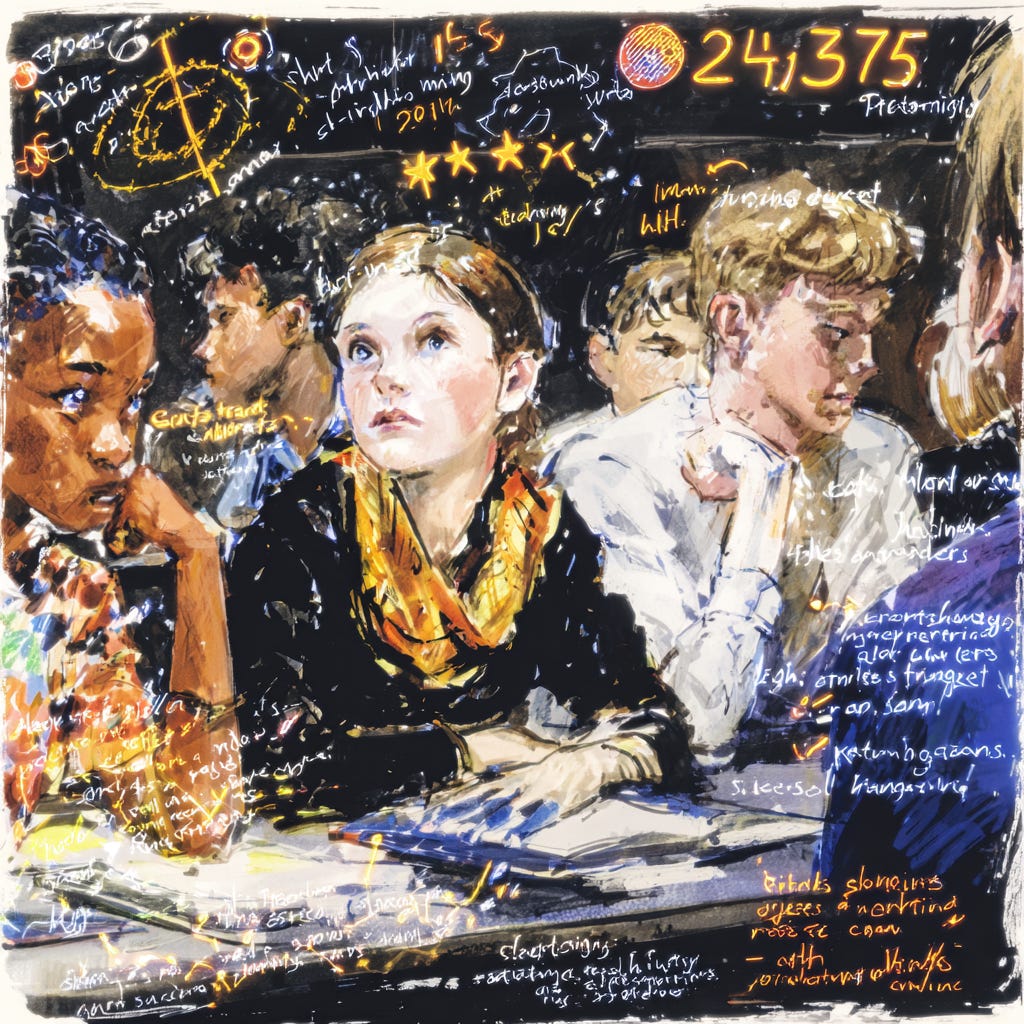
There may even be a newer form emerging underneath this, something some people in the business world call token maxxing. Not development itself, but optimization of the visible signals that systems reward. In schools, children will become increasingly skilled at producing evidence of participation, productivity, engagement and success while the slower work of thinking, wandering, uncertainty, experimentation and becoming remains far harder to see. The danger is not that children adapt. Human beings have always adapted. The question is what they are adapting toward.
I do not ask these questions cynically. I ask them because I think many people inside education genuinely care about children. Teachers are exhausted partly because they care so deeply. Administrators are trying to protect communities under enormous pressure. Families are frightened by the world and want children safe.
But sincerity does not remove the need for reflection.
Because there is another possibility quietly emerging beneath all of this. Children adapting themselves to visibility itself. Children learning the lens. Children becoming highly fluent in performance long before adulthood arrives. And once that thought enters the room, it becomes difficult to ignore.
The child wandering at recess may begin wandering differently if they know they are monitored. The child sitting silently building an idea privately may slowly learn that visible participation is valued more than deep internal thought. Children experimenting socially may begin editing themselves earlier and earlier under continuous interpretation.
Some of the strongest thinkers I have ever worked with would likely have struggled in heavily performative environments. They were often quiet at first. Watching. Gathering. Building ideas privately before offering something extraordinary later. Had we measured visible participation alone, we might have misunderstood them entirely.
This is one of the reasons Montessori observation has always interested me so deeply. At its best, Montessori observation attempts restraint. The adult remains present, careful and attentive, but tries not to overpower the habitat unnecessarily. Observation exists to study development itself. Timing. Readiness. Concentration. Genuine interest. Social formation. Emotional wellbeing. Not simply compliance.
One of the loveliest moments in Montessori elementary classrooms often happens when visitors arrive. In many schools, the weekly meeting manager quietly greets guests, offers water or tea, explains the classroom and gently absorbs the interruption into the life of the environment. The children are not frozen specimens while adults narrate them from outside the glass. They remain participants in the culture itself.
That distinction matters.
The habitat does not entirely surrender itself to the observer.
And perhaps this is where I keep landing emotionally. Not in certainty, but in questioning. What sort of observation culture are we consciously creating for children now? The bird hide, where the observer steps back in genuine curiosity and restraint so development can reveal itself naturally? The deer hide, waiting quietly for correction and capture? The zoo enclosure, where living things adapt themselves to permanent visibility? Or something else entirely that we have not yet fully recognized?
Because if wildlife experts understand that observation changes behavior, it feels increasingly strange that education rarely asks the same question deeply enough about children. Not simply whether children are safe. Not simply whether systems are efficient. But what sort of human being continuous observation slowly produces over time. Because environments always teach something, even when nobody speaks the lesson aloud. A child who grows up constantly visible may eventually learn to become visible first and authentic second. To self-monitor before self-reflect. To perform before they fully discover who they are.
And perhaps the deepest question underneath all of this is not whether we are observing children carefully enough.
It is whether modern systems still remember how to leave enough of childhood unwatched for a human being to emerge naturally at all.
If you wish to follow the research and thinking that inform this work, the books Mapping Montessori Materials for AI Competency Development and Montessori & AI -Volume I are available through my website, katebroughton.com.
Image Prompt: A diverse public school classroom in the near future. Children of many cultures and backgrounds are engaged in “token maxxing,” subtly optimizing visible behaviors for rewards and metrics. Some children sit perfectly upright with glowing progress bars, badges, stars, points, attendance streaks, AI dashboards, productivity tokens, and achievement icons floating around them. Others glance sideways, carefully adjusting posture, raising hands at the right moment, watching screens showing engagement scores and behavioral metrics.
In contrast, quieter children sit at the edges of the room: one staring thoughtfully out of the window at insects outside, another sketching privately, another building an idea silently. Their inner worlds are rich but largely invisible to the system.
The classroom itself feels beautiful yet unsettling, blending school and zoo imagery. Transparent observation glass, subtle camera lenses, tracking displays, and visitors watching from behind viewing windows. The atmosphere should suggest care, safety, and good intentions while quietly asking whether performance has replaced authentic development.
Cinematic realism, emotionally layered, hopeful but unsettling, high detail, natural light, documentary photography style, symbolic contrast between visible achievement and unseen human growth.