The Classroom
The Power of Unnoticed Things

I finally got into the garden today.
I have been watching it move through those strange undulations at the end of winter, although we barely had one this year. Spring had already arrived. Bulbs had come up confidently, leaves had opened, and everything seemed to be moving forward, and then unexpectedly the snow came back. Some of the bulbs survived. Others died back. A few simply carried on as though nothing had happened at all.
I am not an expert gardener.
I was not born with the understanding of optimal planting windows, not taught this at any time since in the school environment. I generally guess, and put seeds where there is an empty space and then I cross my fingers and hope for the best. I move things around frequently and the results are hit or miss, but now I have a new and willing teacher, AI.
Now, I take photographs of the seed packet, the proposed garden space, and enter into the search bar what it is near, positive and negative. I ask questions about whether it belongs there, and what I can plant and it, what might help it to thrive. I also ask for a image of what it will look like in the space, when it is full grown. The images are always unrealistic, or too perfectly realistic to be clearly false, but they give me a general idea. I have not been doing this long enough to find out if the advice works or not, but mostly I play. I consider this fun.
I have also used AI to discern if a plant is truly dead or just dormant, what to clear in a garden bed and what to keep. Although I have learned caution there too.
Gardening has never really been about gardening for me anyway. I remember when my father was ill with cancer in 1989, I was outside one day and almost hacked a bush to pieces. The grief needed somewhere to go. The body needed movement. The sadness needed form. Gardening became a place where all of that could exist without explanation.
The garden accepted it.
Education has always felt strangely similar.
As summer approaches there is this season that most people never see. Educators, have had an exceptionally busy year this year. If educators are not running summer programs or teaching, they can finally rest. However, many educators are already deep into preparation for the next school year and working out how AI will fit into their schools if at all. Heads of schools are planning. Staff development is being finalized. Training is being refined. Environments are being prepared. Most of this work started months ago, often back in January or February. Summer simply becomes the last stage before schools comes back to life again in August.
This year feels different.
Artificial intelligence has arrived in schools with astonishing speed. Many schools have training planned around AI, safety protocols, applications, technology contracts, and new systems. If schools have entered agreements with larger technology companies, they may already have trainers scheduled and materials prepared. What keeps sitting with me is how quickly and seamlessly the corporate world is entering educational spaces.
Education has never been completely separate from outside influence. Testing companies have been with us for years and programs have always found ways into schools. Yet this feels larger somehow. Every application brings another company and every company arrives with its own language around data, analytics, onboarding, workflows, student performance, dashboards, synthesis, metrics, and reporting.
The teacher begins shifting.
Not disappearing, but shifting.
Part of me understands that completely. If these technologies are entering schools, then educators should absolutely be involved in the observation and development. They should be watching carefully, documenting behavior, participating in research, asking difficult questions, and remaining close enough to notice what is actually happening with children rather than what reports say is happening.
Someone still needs to remain in relationship with the child.
That thought keeps returning as I work in the garden.
Who protects the child? I do not mean protection from technology itself. I mean protection from forgetting what learning actually is about, and what embodied education looks like. Including the messy nature of life, learning, and all of our emotions.
It is easy now to imagine efficient systems. Students log in, learning pathways are generated, progress is tracked, curriculum appears neatly organized, and everything looks as though it is functioning. Yet I keep thinking about all the things that do not fit neatly into systems. The child who spends another week on a project because they are still fascinated. The group who continue researching because curiosity has not finished with them. The unexpected observation that redirects an entire line of inquiry.
I think about the potato vine that once grew across our classroom because nobody wanted to stop it. The children carefully stepped over it on their way to the shelves and stepped back over it when they returned. I think about the praying mantis egg sac, the little terracotta gardens, the cat grass measured against the window with rulers, and children kneeling beside seedlings with complete seriousness as if the fate of the plant rested entirely in their hands.
Those moments rarely make it into reports.
They are small.
Almost invisible sometimes.
Yet, they are always where development is happening.
I speak often about Montessori because I believe it arrived prepared for this moment, not because it contains more technology but because it begins with the child and ends with the child. The curriculum sits openly on the shelves. The materials wait. Children move deeply into work when interest takes hold. We observe. We document. We prepare the environment. If a child reaches the edge of something and wants to go further, we extend the environment and place the next interesting work as a possibility in their path.
The classroom changes because the children change.
It stretches and it breathes.
And perhaps that is why I found myself back in the garden today, clearing what looked dead while leaving what might only be sleeping. Gardens ask us to observe before interfering. They ask us to notice before correcting and to wait before concluding that something is gone.
The classroom was always meant to be like that, flexible, fluid, prepared for all eventualities.
Years ago, long before artificial intelligence entered schools, I wrote an an observation piece for my Masters degree with TIES, a poem called The Classroom. Reading it now, I realize it was never really about shelves, books, materials, or routines. It was about relationship, preparation, trust, and the extraordinary privilege of standing quietly beside human beings becoming their full selves.
I share it with you now with all my love and respect for the work you are doing at this time. Maybe, you will share your own observation and poetry with the world about this too, when the moment arises.
The Classroom
“The Prepared Environment”
Kingwood Montessori School
Class 214
Softly breathing the morning air
Clutching another box of dog-eared books to my chest
Placed down carefully in the darkened room
Waiting in anticipation for the day
The lamp first
Always the lamp which illuminates the mat
The precious black mat
A three foot by two foot piece of no-man’s land
Of wonder and weaving spells. Don’t tread on the mat!
Be careful of the books!
The spider
The mirror
The marbles
Be careful of the secrets
And the science
The stories and the writers
Walk around the mat
And wait until
The moment of revealing
All will be well
The light is on now
Eyeing the room
Plain wood shelves
Sets of neat colored cards
Wisdom
Order
Classification and position
Not the right and wrong
But the order out of the chaos
The order that settles the mind
One set is crooked
A small adjustment
It’s straight now
Breathe again
A quiet stroll around the room
In the silence
The blissful silence
That in fact
Will not be broken
When the children arrive
For this silence
Is unbreakable order
And peace
This is a perfect silence
A silence of love
And clarity
That may at times be noisy
But silent all the same
It’s a silence of anticipation
And ambition
Expectant silence
Like opening a birthday present
Potentialities float around the room
Like dust
Caught in a morning ray of sunlight
Potential understandings
Enlightening
Potential “Ahas” and “Ahs”
The gold lined
Black leather dictionary
Sits with the weight of ages
And waits for the first soft fingers of the morning
Thumbing the pages
For the right order of letters
Fumbling the corners
Following the words with skinny fingers
Searching and searching
And thumbing and looking and pointing
And then it sits patiently
Beside the child
As they place this knowledge upon the lined page
Quickly at first
To gain the prize of the find
And then almost musically
The lyrical sounds of the words
Find their way into hesitant cursive
Flowing the curves upon the page
In leaden grooves
Scroll and pause
Bend and curve
And then again
And now
The stroke
And line
And curve
And the dance
Of cursive
Goes on
And the child
Measures the words
With puzzlement and wisdom
And when all is done
Sits spellbound
At the beauty of their work
Another step across the room
Sees the classroom pet
The Beta fish
Whose name is ‘Ike’
Ike came from the hurricane
Of the same name
Named for the wind
And the water
The tumultuous entwinement
Of high and low pressure
Ike sits serene
Belying his name
His simple home
A catalogue of stories
And exploits
And forgotten feedings
And careless cleanings
Ike is resilient
If nothing else
And next to Ike
Trevor and Steve
Two tiny frogs
And their snail Patricia
Who takes good care of them
This little eco family
Spend their days
Frolicking and fighting
And nibbling
And having big eyes
And even bigger noses
Pressed against their small plastic cubicle
Like performers in a watery stage
They wait for their moment
To show off their froggy habits
For keen observers
But the garden
Oh! For the garden
This small terracotta container
A world of delight
Dug to death, weeded and watered
Seeded and seeded and seeded again
Watered and weeded and seed upon seeded
Then measured and molded and seeded gain
If it were possible to force nature to make a seedling appear from the ground
This would be the place.
This is where the wills of many have created miracles
The ‘Trail of Tears’ beans were first this year
Followed by the ever-forgiving Sweet Pea
Then finally our prayers were answered
Did you know cat grass can grow in days?
And that you can actually watch it growing?
You can see the cells gathering food from the sunlight
That squeezes its way between the blinds
At the windows
And forces the shoots ever upwards
To be caught by a small plastic ruler and placed neatly into a journal
Did you know children can force plants to grow just by loving them?
Did you know there is no such thing as overwatering?
Until we are paddling in the soft river that glides through the classroom
Did you know it was just enough?
It didn’t feel moist from the top
But beneath it was a raging torrent
Did you smile as they discussed the flow?
But never offer to assist in either word or deed Instead, you observed them as the worked together to stem the flow.
And when you saw a child apparently struggling with their math
Did you know to offer support?
Or did you know to sit quietly
And wait
And wait
And watch Until a smile And the warm glow of satisfaction filtered across their face
Did you know?
So the clock ticks
And the environment is prepared
And the cards wait
And the lined paper smoothes
And the old books sit up and peer at the door
And no bell rings
But the music starts
Softly
Elegantly
As if Mozart himself
Was there
And the children
One by one
Glide into the room
And go about their business
A backpack stored
A folder filed
A seat warmed
And now settling
And reading
And the silence breathes
And the rooms breathes
And we all smile
And the dance begins
Because the children are finally here
If you wish to follow the research and thinking that inform this work, the books Mapping Montessori Materials for AI Competency Development and Montessori & AI -Volume I are available through my website, katebroughton.com.
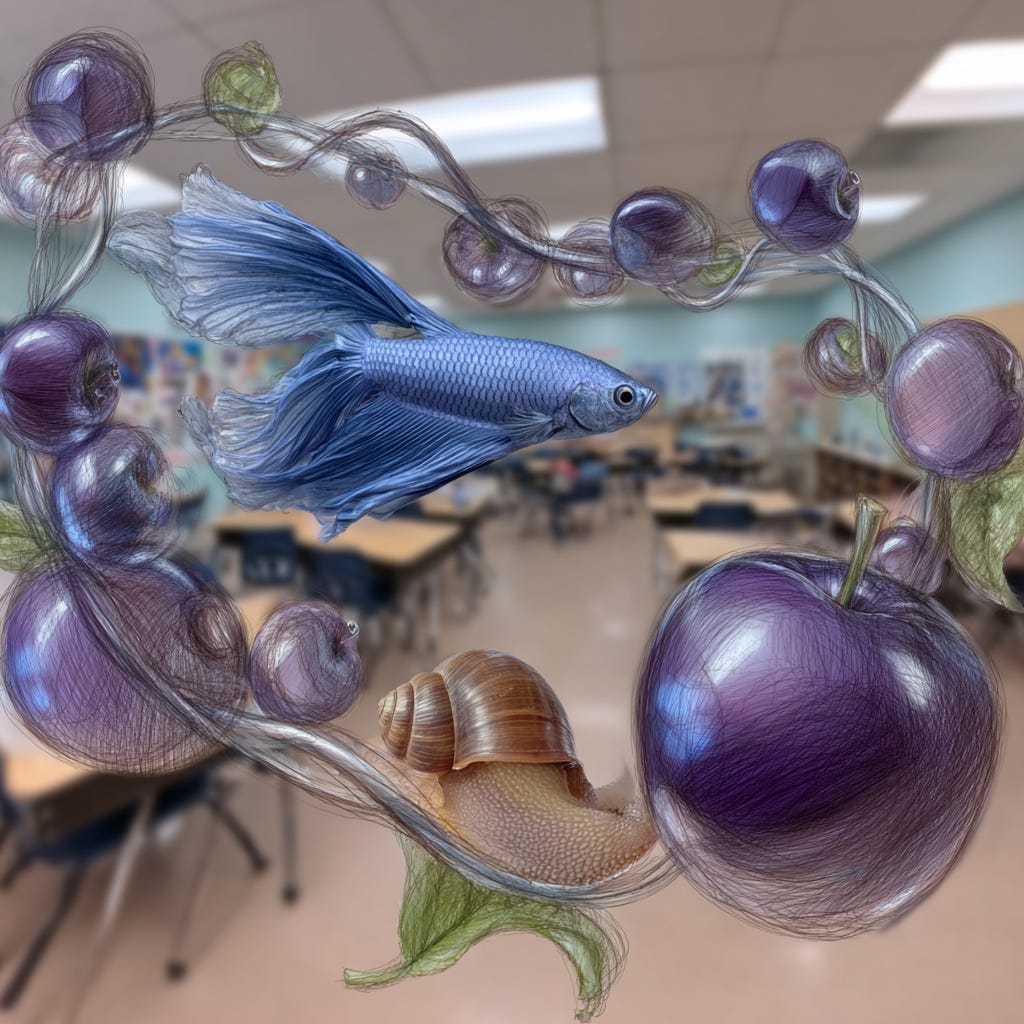
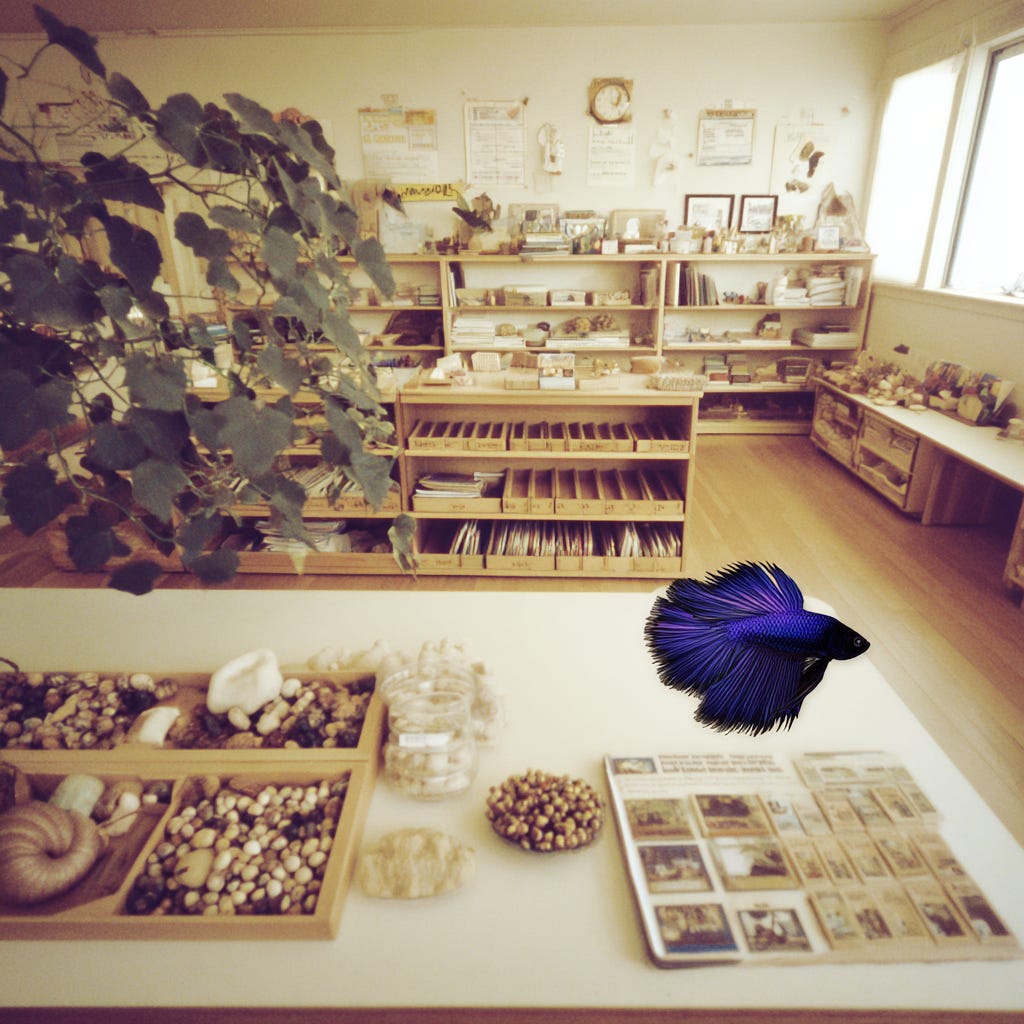
Image Prompt, I have included two version of the image creation. One was trained on my Montessori image board and my personal art board, and the other was based on the Montessori board only: A Montessori classroom, peaceful, loved, waiting for the children to arrive at school. A blue purple dazzling beta fish, two frogs, a snail, and a long potato vine circles the classroom.