The Children We Cannot Measure
Discomfort, Monocrops, Silence, and the Narrowing of Human Thought

I had just arrived at the foothills park where there are these little artist installations that people leave by the riverbanks. Nobody officially puts them there. People just place them quietly because they feel moved to. I always love that about this place. It feels reflective and human and slightly unfinished in the best possible way.
I put my feet into the water, as I often do there, and the water was still very low down, very low down for this time of year. It was cold. Not invigorating cold. Uncomfortable cold. And within a few moments I realized that I felt physically uncomfortable enough that I could not properly settle into myself.
So I walked back to the car to get my jacket and then came back down to the river again. But what interested me was not really the fact that I was cold. It was what the discomfort interrupted.
I could still speak. I could still technically record thoughts. But I could not think in the relaxed and connected way that I normally do when I walk. Usually when I come here my thoughts move very fluidly. One observation leads into another and then another. Questions emerge. Patterns emerge. I notice something beautiful, then something troubling, then something interesting, then something contradictory. My brain tends to move continuously in that way.
There are not many things that stop my thinking.
But discomfort stopped it.
Because once I was uncomfortable, part of my attention shifted toward trying to resolve the discomfort. I was looking for warmth. Looking for stability. Looking for what would allow me to settle again into reflection. And I suddenly realized that if this can interrupt me during ten minutes beside a river, then I am not alone in this experience at all.
There are millions of children spending every day inside environments where discomfort is constantly interrupting their thinking.
And not dramatic discomfort necessarily. Sometimes very small discomforts. The seam on clothing rubbing against the skin of a highly sensitive child. Fluorescent lights. Noise levels. Bells. Anxiety about transitions. Emotional uncertainty. Social pressure. The feeling that the room itself does not feel safe or logical or calm. Sometimes simply the feeling that what is being asked of them does not make sense to them internally.
And adults often underestimate how much energy it takes for a child to function while uncomfortable.
Because children are already carrying so much movement internally. Thoughts, evaluations, observations, concerns, tangents, questions, sensory information. Their minds are already alive with activity. Then on top of that we add environments that can feel physically or emotionally dysregulating and afterward we evaluate the child as though their performance existed independently from those conditions.
Sitting there by the river, unable to sink naturally into my reflections because I was cold, I started thinking about my own school years. And what is strange is that I do not remember most of the curriculum at all. I do not remember many worksheets or lessons or grades. What I remember very clearly are the environments in which I felt stopped.
Not stopped deliberately by teachers. I do not mean that educators were intentionally suppressing me. But I remember environments where internally I would feel friction constantly. This does not feel logical. This does not feel right. Why are we doing this? Why does this room feel so strange? Why are we sitting inside all day? Why does everybody else seem to understand how to move through this naturally when I do not?
And because we moved so often growing up, because my father was attached to the forces and we travelled repeatedly, every few years there was another school, another culture, another structure of expectations. Each environment had its own invisible rules and every time I would look around and think, everybody else seems to get this. Everybody else seems to understand the rhythm and the expectations and the routines.
So eventually silence became adaptive.
Silence became my best defense. If I stayed quiet enough, followed instructions, completed the work, kept my head down, then I could move through the system safely enough without exposing how disconnected from it I often felt internally. Silence restored some level of inner stability because if I did not make myself too visible, then I did not have to fully confront the possibility that maybe I was the problem.
Maybe I was illogical.
Maybe I was overly sensitive.
Maybe how I saw the world did not make sense.
Maybe I simply did not understand what everybody else understood naturally.
And years later, speaking with children who had moved from Montessori classrooms into more conventional public systems, many described something very similar. They learned how to navigate the machinery. Which teachers deeply read their work. Which teachers really wanted engagement and thoughtful conversation. Which teachers could be gamed. Which systems rewarded compliance over thoughtfulness. Which assignments required genuine effort and which only required performance.
Children become extraordinarily skilled at adapting themselves to systems, even systems that are not especially healthy for them.
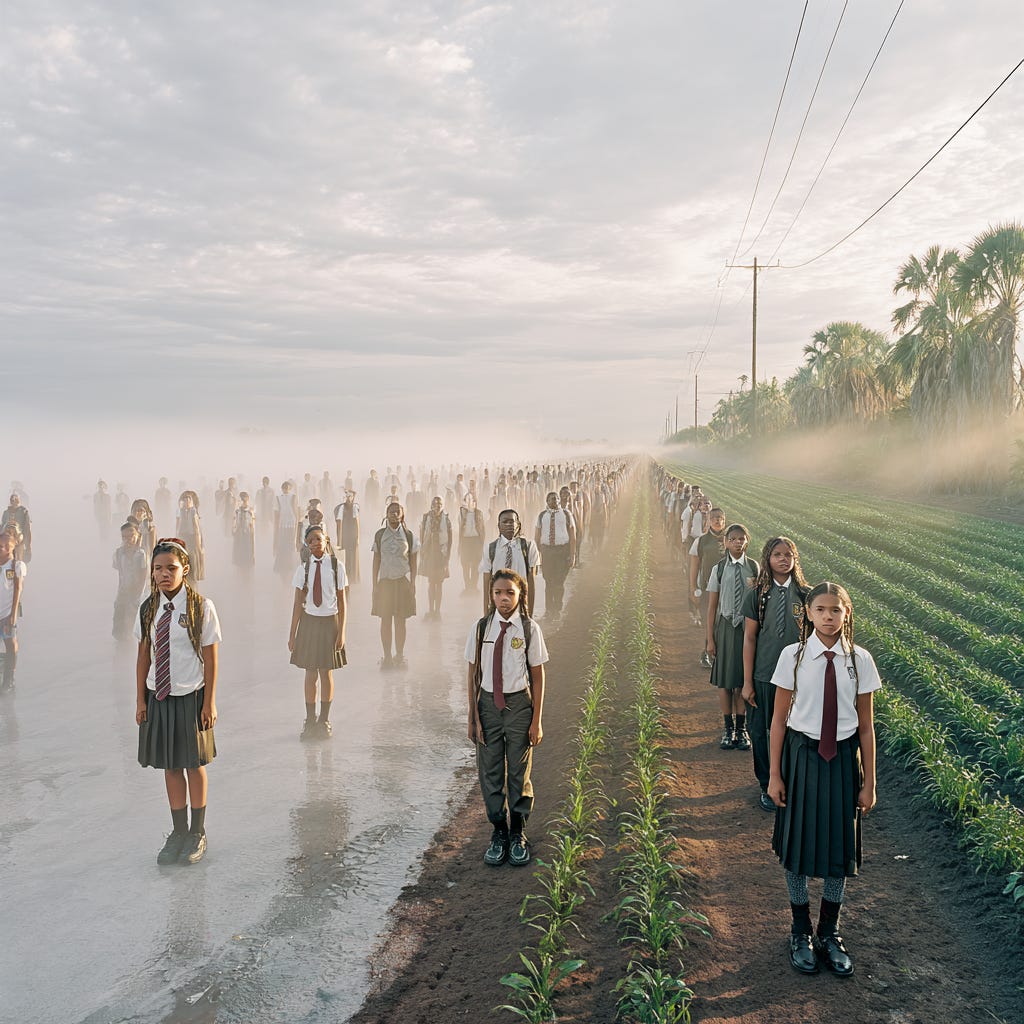
And this keeps bringing me back to the monocrop metaphor.
Yesterday I had been writing about alfalfa fields. If you plant one crop across an entire field, you cannot then act surprised when only that crop grows. You planted alfalfa. Of course you are going to get alfalfa.
And even then, the dandelions still try to emerge. Mullein still appears. Wild plants still try to find little corners where they can survive, even in poor soil, even where conditions are barely supportive of life. Nature keeps trying to diversify itself.
But we seem genuinely surprised when children emerge from educational systems increasingly looking like monocrops themselves.
And not especially healthy monocrops either.
We do not have to search very hard now to find children struggling profoundly with anxiety, depression, disengagement, exhaustion, hopelessness, loneliness, or simply not thriving in school environments. And at this point in history, if we are not organizing education around human flourishing, then what exactly are we organizing it around?
And now artificial intelligence enters this landscape.
What concerns me is not simply AI itself, but the possibility that we are layering AI onto already monocrop based systems of education. We are asking children to become users before they have become thinkers. Users before historians. Users before investigators. Users before creators.
Many children are now being introduced to AI primarily through use:
learn the platform,
learn the tool,
learn the interface,
learn how to produce outputs efficiently.
But if children only become users of systems they do not understand historically, philosophically, politically, technically, or economically, then we are narrowing the field even further.
And I think about this often with image AI systems because over time they begin learning your preferences. They begin returning aesthetics and compositions and emotional tones that you repeatedly respond positively to. The system starts reflecting your own taste back to you so successfully that it feels comforting and familiar and affirming.
But it is a little bit like having a friend who constantly tells you how wonderful you are.
You are brilliant.
You are beautiful.
You are insightful.
You are extraordinary.
At first it feels lovely.
But eventually something inside you realizes that no genuine relationship functions entirely through affirmation. Real relationships involve honesty, disagreement, friction, challenge, misunderstanding, repair. The people who help us grow are not always the people who make us feel most comfortable all the time.
And friendships themselves are ecosystems too.
Hopefully we have all sorts of people around us. Roses with large thorns. Dandelions. Snowdrops. Hardy desert plants. Wild jungle growth. Different personalities, different truths, different ways of seeing the world. That diversity helps us discover what kind of human being we are ourselves.
And what is interesting is that many of the things we dismiss as weeds are actually medicinal herbs. Dandelions are beneficial. Nutritious. Useful. But we have culturally agreed that they are undesirable because they interrupt the cultivated field.
Children often experience school in exactly the same way.
The system is correct.
The worksheet is correct.
The pacing is correct.
The curriculum is correct.
And the child slowly learns that much of their energy becomes organized around discovering what answer will make the authority figure say, Correct.
Then eventually we attach grades to that process and behave as though those grades accurately represent the child.
Even now.
Even in the age of AI.
Even while students may quietly be using sophisticated AI systems to generate polished work that moves seamlessly through structures designed for a completely different era.
And still we continue acting as though our measurements are stable and objective.
The deeper issue is not really cheating. The deeper issue is that many of the systems we use to measure human intelligence and human understanding were already unstable before AI exposed those weaknesses more visibly.
And I keep returning to the river.
For ten minutes I could not properly settle into reflective thought because I was cold. That was all. Just cold. I had language for what was wrong. I had agency. I could retrieve my jacket. I could regulate the environment.
Many children cannot.
Many children spend years inside environments that subtly dysregulate them while simultaneously being evaluated as though their performance exists independently from those conditions.
And I do not understand how we continue pretending that those measurements accurately represent human potential.
Especially now, when the future itself feels increasingly uncertain and what we need are not compliant monocrops, but thoughtful, adaptive, deeply rooted human beings capable of thinking clearly in changing conditions.
If you wish to follow the research and thinking that inform this work, the books Mapping Montessori Materials for AI Competency Development and Montessori & AI -Volume I are available through my website, katebroughton.com.
Image Prompt: At dawn, endless rows of multiracial, diverse, boys and girls in school uniform, standing as though planted like a monocrop across a vast agricultural field, evenly spaced beneath industrial irrigation systems spraying cold mist through the air. They face forward in silence, yet signs of individuality begin to emerge, one child turns toward the rising sun, another holds a wildflower, another stands barefoot in the soil. The earth is cracked between the rows while radiantly dazzling wild plants begin appearing at the edges of the field.
Brilliant, Kate.