Staying With What Is
A Reflection on the Discipline of Observation

What I learned early, and then relearned every single year I was a head of school, is that whatever we resist tends to persist and harden. I learned this not as a slogan but through daily practice. My door was always open. Teachers came in frustrated, sad, frightened, defensive, overwhelmed, or angry. Children came in dysregulated, exuberant, collapsed, or guarded. My task was not to match their energy. Not to counter it. Not to fix it. My task was to lower my resistance as close to zero as I could manage and to stay there.
If an adult meets an angry teacher with equal frustration, or a frightened child with defensive authority, the field escalates. This dynamic is well articulated in Eric Berne’s transactional analysis, which explains how we unconsciously shift between parent, child, and adult states in relationship.
The adult position is deceptively spare. No reaction. No evaluation. No judgment. Just reflective listening and genuine interest. A kind of nothingness that is not empty at all, but open. Inquiry lives there.
This way of being has shaped how I think about resistance far beyond school walls. We live in a time saturated with opposition. Oppose this. Fight that. Name, shame, correct. The intensity feels necessary. And yet I keep returning to what both relational psychology and physics quietly agree on: attention is not neutral.
In quantum physics, a system does not resolve into a particle or a wave until it is observed. Observation collapses possibility into form. This is not poetic metaphor; it is foundational science, explained clearly in introductory materials from MIT’s Department of Physics, and Stanford’s quantum mechanics resources.
What we attend to grows. This does not mean we deny suffering or ignore injustice. It means we become disciplined about where and how we place attention.
I think of the twenty-four Buddhist monks who are currently walking in single file across the United States. They were not shouting. They were not performing outrage. Their discipline is not resistance but non-reactivity, what Zen traditions describe as “no-mind.” Not the absence of feeling, but the absence of compulsive judgment. Research summarized by the American Psychological Association on mindfulness-based attention training shows reduced reactivity and increased emotional regulation.
Montessori environments are built on this same discipline, though we rarely name it that way. In our school, we practiced walking meditation, in a lesson called Peace and Service. Amongst other practices, the elementary children would walk slowly through a familiar space, like the playground, and in their minds describe what was present, correcting themselves when mental language slipped into opinion.
I want to stay here for a moment, because this is where the work actually is.
So, I am walking on a sand and gravel path approximately three feet wide, located along the foothills in Colorado. The time appears to be late afternoon in winter. The ambient temperature is approximately 30 degrees Fahrenheit. The sun is low in the sky, producing a long shadow extending from my feet.
Vegetation adjacent to the path is brown and lacks visible green foliage. There are small, dry plant fragments on the ground. Based on prior experience, these resemble tumbleweed; this identification is uncertain.
Motor vehicles are audible and visible on nearby streets.
A crunching sound occurs with my steps. The sound may be produced by my boots contacting the gravel surface.
The air has a cold odor. No pine or green plant scent is detectable. A faint agricultural odor is present. There is the sound of an airplane passing overhead, moving south.
Paper, plastic, and metal objects are present on the ground. Several appear to be food or beverage packaging. Some items display partial or complete product names. One object is labeled “Arizona Matcha Mango Tea.” The container is empty of liquid. The statement that someone discarded it is an assumption. The verifiable fact is that the item is located on the ground.
Footprints are visible on the path. They vary in size, indicating multiple shoe dimensions. Parallel linear marks are also present. These may have been produced by wheeled objects such as bicycles, pushchairs, or carts; this cannot be confirmed.
Wood fragments are present, most measuring less than one foot in length and approximately three inches wide. Additional food wrappers are visible. One wrapper measures approximately four inches by three inches and displays the name “Ziggy’s.” A separate empty bag is located approximately four feet away. The bag is cool to the touch.
A piece of corrugated cardboard is present approximately one foot east of the path. It measures roughly four inches by two inches. The edges are irregular. The surface is concave. The interior surface is slightly moist.
In a Montessori classroom context, such materials may be collected and disposed of unless they are of interest. In some cases, children may choose to document observed items, for example by recording product names or quantities. This activity would be descriptive rather than evaluative.
Out of interest, not outrage, inquiry begins.
Walking meditation was never about escape. It was about training attention. Children would take turns leading the group, ages six to twelve, the leader thinking about safety of the students behind them. Leadership emerges naturally when authority is shared.
Now I am near a playground. Several drink bottles are present, including a sports bottle and a “Fair Life” high-protein drink bottle. An empty “Ziploc” bag measuring approximately six inches by six inches contains crumbs and is slightly expanded, indicating prior use.
This is not a time to think we know anything. That illusion has collapsed. At best, adults are equal to children now in not knowing what the future holds. What we have, as the monks remind us, is this moment.
A clear January day. Fresh air. School dismissed. A bicycle rack mostly empty. Six bicycles and one tricycle remain. A dog passes. I think “beautiful dog,” and I catch myself. That is judgment. The fact is that it is a cream-colored dog, approximately two feet tall and 15 inches wide, standing on a wooden structure in a garden to my right.
This practice matters now more than ever because children’s attention is being systematically pulled away from direct experience. Large-scale reviews summarized by the World Health Organization link excessive screen exposure to increased anxiety and sleep disruption in children, and peer-reviewed studies in JAMA Pediatrics document associations between screen use, attentional difficulties, and emotional regulation challenges.
When families are absorbed by devices, children learn that fractured attention is normal. When adults are present, children encounter reality, which is sometimes uncomfortable, sometimes boring, sometimes beautiful, and always instructive.
Montessori never asked children to withdraw from the world. It asked them to meet it directly, through the body, the senses, and sustained attention. Walking. Noticing. Correcting language. Staying with what is.
This is not softness. It is discipline. And it may be one of the few disciplines left that can help children grow into a world where certainty is gone, authority is unstable, and attention itself has become the most contested resource we have.
The work is not louder resistance. It is steadier presence. Not better answers, but better attention. The kind that does not rush to judgment, does not flinch from uncertainty, and does not forget that every future worth inhabiting begins with a child who is allowed to notice what is actually in front of them.
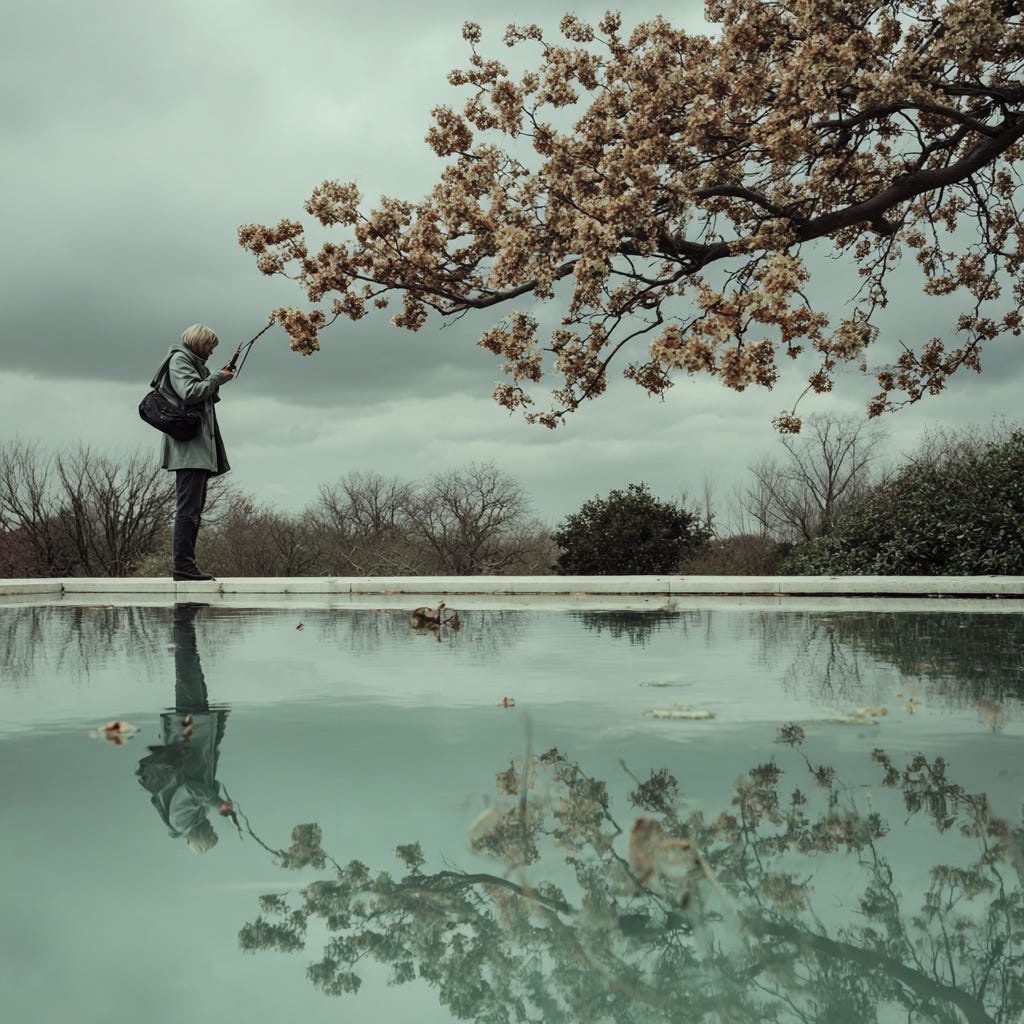
A reminder about these Midjourney images and videos. I put the title and subtitle of the Substack post into the Midjourney prompt bar, and then select from the results with an educators and artists eye. These images are designed to stir up thought and discussion.
If you wish to follow the research and thinking that inform this work, the books Mapping Montessori Materials for AI Competency Development and Montessori & AI -Volume I are available through my website, katebroughton.com.