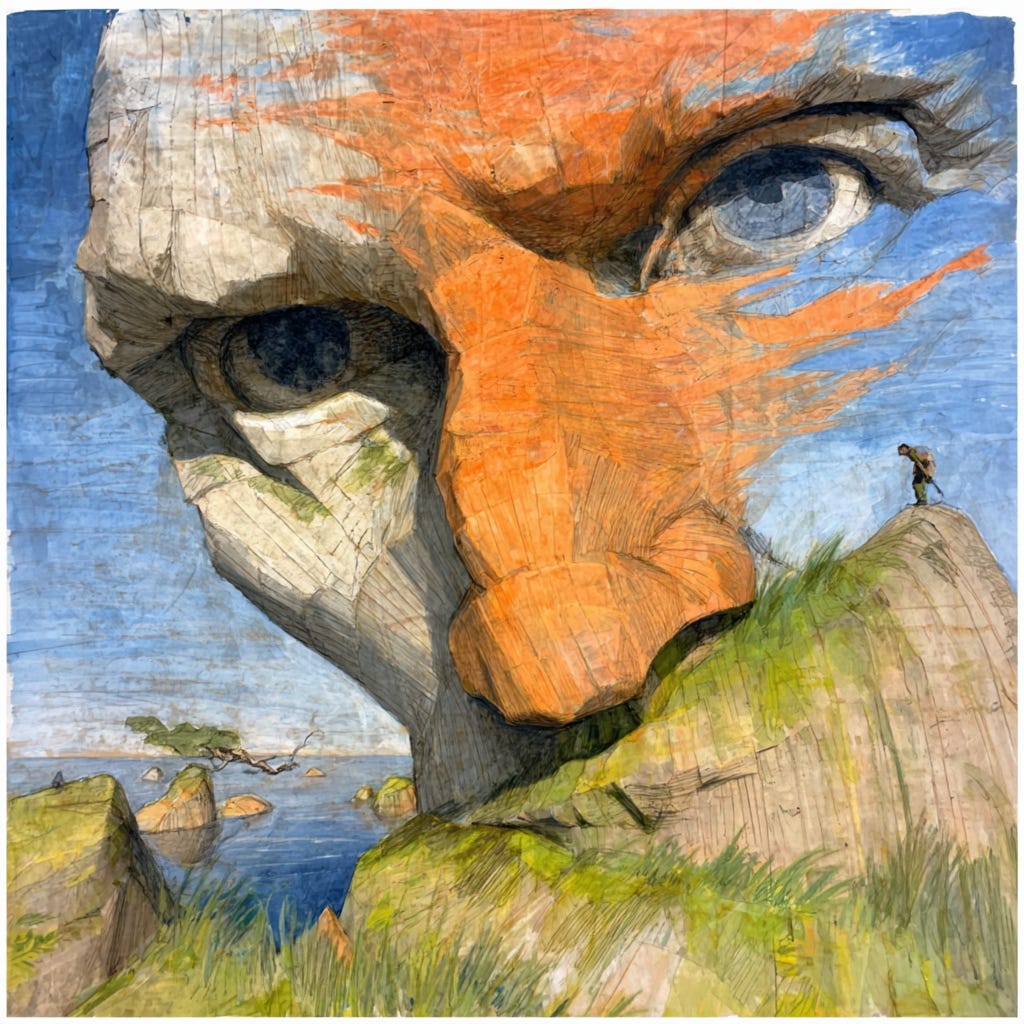
Outsider
Where Do You Stand to Get the Full Picture?

Someone wrote, on Substack, that if you are not in the classroom you cannot know what today’s children are like. It was not written to me. I came across it the way you come across most things in the long scroll of other people’s thinking, which is to say sideways, half by accident, and then unable to leave it alone.
I have been sitting with it since. Not because it stings, though I understand why it might sting someone. But because it raises a question I think is genuinely worth asking, and worth asking carefully, without defensiveness or dismissal. Are today’s children so particular to this moment that only those standing inside a classroom in 2025 or 2026 can understand them? Or is there something about childhood itself, something structural and constant, that remains visible from other vantage points, perhaps most visible from a little distance?
It is not a small question. It touches everything.
Let me start with what teachers are actually seeing, because it would be a mistake to wave the question away. The reports are consistent and they are serious. Children are arriving in classrooms more dysregulated than before, prone to outbursts that surprise even teachers who knew them as settled learners the previous year. Attention is fragmenting. Transitions are harder. Anxiety sits closer to the surface. Collaboration, which children once came to naturally, now requires more scaffolding than it used to. In a 2025 survey, three quarters of elementary school leaders confirmed this pattern, and the percentage of schools where teachers say they need more support with classroom management has climbed from just over half to nearly two thirds in three years.
There is also a cohort effect that will be moving through classrooms for years. Children born during the pandemic entered the world in conditions that disrupted the ordinary texture of early development. Researchers at Brown University found that toddlers born in those years showed measurably lower verbal, motor, and cognitive performance compared to those born in the previous decade. Those children are in first grade now. The wave has not crested.
Screen exposure at home is woven through almost every teacher account of what has changed. Too much time on devices, too early, with too little of the physical and relational experience that builds the architecture children need before they can regulate themselves, sustain focus, or tolerate the ordinary frustrations of learning. Only thirty percent of eighth graders are reading proficiently. No state has shown gains since 2022.
So yes. Something is different. The teachers are right to say so, and they are right to want that acknowledged.
But here is where I want to slow down and look more carefully. Because the question is not only whether these children are different. The question is whether they are different in kind, or different in degree. Whether what we are seeing is a new human, or a familiar human under conditions of unusual pressure. And that is a question you cannot answer from inside the classroom alone. To answer it, you need to be able to see across time.
Dr. Maria Montessori was observing children in Rome at the turn of the twentieth century. The children she worked with in the Casa dei Bambini were not children of privilege. They were children of poverty, of disrupted families, of environments that offered little order and less beauty. They came to her dysregulated, inattentive, behind in language, thin in the habits of concentration that formal learning requires. She did not conclude that these children were broken. She concluded that they had not yet been given what they needed, and that what they needed was something the environment that she had designed through scientific observation and iteration, could provide.
What she built in response, the prepared environment, the three-hour uninterrupted work cycle, the practical life exercises, the sensorial materials, the freedom within limits, was not designed for an idealized child. It was designed for the child in front of her, the one whose attention had never been properly cultivated, whose hands had never been given purposeful work, whose nervous system had never learned to settle into the rhythm of a chosen task. The method did not demand that the child arrive ready. It created the conditions in which readiness could develop.
Now look at the list of what teachers are reporting today and hold it against what Montessori built.
Dysregulation. The prepared environment is itself a regulatory scaffold. Its order, its predictability, its pace, its freedom from coercion, all of these reduce the need for the nervous system to stay on alert. Research published in the last two years finds that Montessori students’ inner experience of school shows the strongest effect size of any measured outcome. Children who feel purposeful and in control of their own choices do not need to explode to communicate.
Fragmented attention. The three-hour work cycle is the structural answer to a world that has trained children to expect interruption. Executive function shows a strong effect size in Montessori outcomes research. Practical life exercises introduced into conventional kindergarten classrooms have been shown to measurably improve attention. Deep, self-chosen, uninterrupted work builds the neural architecture that screens erode.
Developmental delay in motor skill and language. Practical life work directly addresses this. The aims of those exercises, beyond the skills of independent living, are specifically to build gross and fine motor control and eye-hand coordination. Motor and language development are more tightly linked than most people realize. Research confirms that both gross and fine motor skills actively foster language development from infancy through early childhood. Montessori understood this a century before the neuroscience had the language for it.
Disengagement and apathy. Intrinsic motivation is not an aspiration in a Montessori environment. It is the foundation. The work is real, it has consequence, it is chosen, and it is completed. A child who has tasted the satisfaction of genuine understanding does not find outsourcing their thinking to a machine particularly appealing.
Weak social skills. Mixed-age communities and collaborative work are not add-ons in this model. They are structural. The research identifies Montessori as more effective in developing social skills, and Montessori students demonstrate, measurably, the ability to understand and manage their own emotions and to extend genuine care toward others.
Literacy crisis. Studies of public Montessori schools show students performing significantly better in reading than peers in other magnet programs, across race, language background, and socioeconomic status, without any emphasis on standardized test preparation.
I am not making an argument for complacency. The scale of what teachers are managing right now is real, and they deserve support that is both practical and immediate. But I am making an argument about what it means to understand a problem. The teacher in the classroom sees the child in front of them, and that seeing is irreplaceable. It is granular, embodied, responsive in real time. No amount of reading or research replicates it.
And yet. The teacher in the classroom in 2026 is also, necessarily, inside the moment. The pressure of the present makes it harder, not easier, to see the shape of what is happening. To know whether this represents a break from everything that came before, or whether it is the latest iteration of a crisis that has always been there, intensifying under conditions that were never designed for children in the first place.
The people who can see across time are not always the people in the room. The historian, the researcher, the teacher educator, the practitioner who has moved through decades of classrooms and is now working at the level of theory and policy, these people are not ignorant of the child. They are looking at the child from a different angle. And the full picture requires both.
Montessori herself moved constantly between these positions. She observed, she taught, she theorized, she wrote, she lectured across continents to audiences who had never seen her work directly. She did not believe that the value of her observations was diminished by the distance between the Casa dei Bambini and a lecture hall in London. She believed, and the century of research since has borne her out, that what she had seen was true of children as such. Not just Roman children. Not just poor children. Not just children of a particular decade.
The child is, in some deep sense, constant. The sensitive periods do not shift with the cultural weather. The need for order, for movement, for language, for purposeful work, for genuine connection with other people, these do not change. What changes is the degree to which the environment around the child supports or suppresses those needs. What changes is the acuity of the symptoms when the environment fails.
What we are seeing in classrooms right now is not a new child. It is the consequence of an old mismatch, between what children fundamentally are and what the systems around them have been designed to produce, made visible by conditions that have pushed the gap beyond what ordinary classroom management can absorb.
You do not have to be standing in the classroom to see that. You have to have been paying attention, across time, to the child.
That is a different kind of knowing. It is not lesser. It is not uninformed. And in this particular moment, with so much noise about what is new and unprecedented and unlike anything we have seen before, it may be exactly what is needed.
The outsider, it turns out, is sometimes the one who can still see the whole picture.
Not because they are removed from the child.
But because they have never stopped watching.
If you wish to follow the research and thinking that inform this work, the books Mapping Montessori Materials for AI Competency Development and Montessori & AI -Volume I are available through my website, katebroughton.com.
Image Prompt: Where Do You Stand to Get the Full Picture?