Look Up
Reading the World Before the World Reads You

There is a river near where we live in Colorado. Most years, by late winter, it is bouncing and tumbling with snowmelt, audible from the path before you can even see it. This year it is next to empty. The riverbed is exposed all the way across. Where the current used to run, there are already heaps of stone with grass growing between them, small islands that have no business existing yet, not in April, not here. I come to this river regularly. Sometimes I put only my feet or hands in the cold water. Sometimes, further upriver, I go in whole. But this week, I look along the river, I look up, I stand at the edge, and simply looked at what was not there, and feel the particular weight of a thing that has disappeared quietly, without announcement, without sirens.
We are very good at sirens. When the tide goes out miles in the minutes before a tsunami, communities who have been taught to read that sign know immediately what it means and they move. There are now sirens and alert systems for the large, catastrophic events. But there is a whole register of signal that sits below the threshold of the siren, subtle and patient, and we have trained ourselves, and our children, to wait for someone else to interpret it. Someone else has this. Someone else will let us know. There are agencies, systems, departments, professionals whose role it is to monitor and notify. We have outsourced our perception.
In Colorado, wildfire can begin in minutes. The conditions for it are not mysterious. Dry brush, wind direction, temperature, humidity, the color of the grasses in a field you pass every day on the school run. These are readable signs. They are the kind of information that used to live in the body of every adult who spent time outside, and before that in the body of every child. But we do not teach children to read them. We do not ask whether their school has a single lesson in which a child is invited to look at the underbrush and ask what they notice. We have firefighters. We have police. We have systems. And we do, still, have those things, though the systems are changing faster than we are willing to acknowledge, and the question of who will let us know is becoming more complicated by the season.
What education has done, over a very long time and with the very best of intentions, is to produce children who look elsewhere for the answer. The teacher holds the answer. The textbook holds the answer. The standardized test will reveal whether the child has successfully absorbed the answer. Every element of the conventional classroom architecture communicates, reliably and daily, that the locus of knowledge is outside the child. Look here. Wait. I will tell you what to do next. I will tell you when to move, what to wear, what matters, what does not. Children absorb this instruction at a cellular level. They are very good learners. They learn exactly what they are taught.
Dr. Maria Montessori observed dynamics like this, with considerable precision, over a hundred years ago. She described the conventional school as a place in which the child is immobilized, their natural impulse toward exploration and self-direction replaced by enforced passivity and dependence on external direction. She used the word cosmic task to name what each child carries: a particular sensitivity, a particular form of attention, a way of being present in the world that is not incidental but essential, both to the child’s own development and to the larger work of humanity. There are children for whom connection to the natural world is not a hobby but a vocation. Children who feel the quality of air pressure change before rain, who notice when a hillside has dried beyond a certain point, who wake from sleep aware that something in the environment has shifted. These sensitivities are not childish fancy. They are data. They are the oldest form of intelligence we have.
Montessori shared that the prepared environment was the condition under which the child’s natural development could unfold without distortion. But the prepared environment was never only the indoor classroom with its beautiful materials on low shelves. It was always also the world outside, the garden, the field, the sky. The child in a Montessori environment is trusted to observe, to move toward what interests them, to register what they notice and to act on it. When a child in a Montessori classroom says, I think the plants need water, they are not asking permission to have a thought. They are practicing the cycle of observation, inference, and response that is the foundation of all genuine intelligence. That cycle, repeated ten thousand times in a protected and attentive environment, becomes a habit of mind. It becomes the self.
From the child’s position, the message of conventional schooling is extraordinarily consistent: Your instincts are not reliable. Your observations require adult validation before they count. Your sense that something is wrong, or right, or interesting, or important is not curriculum. Sit down. Wait. I will tell you when it is time.
The tragedy of this is not only that it suppresses the child’s natural development, though it does. It is that the child believes it. Children are predisposed to trust the adults who structure their world. If those adults, daily and systematically, communicate that the child’s inner sense is not to be trusted, the child incorporates that message as identity. I am not the kind of person whose instincts are worth following. I need to check. I need to ask. I need to wait for permission to know what I already know.
Families who live close to the land do not generally produce this kind of child. Farming families, families who fish, families who have stayed in one place long enough to know it across seasons, these families train their children incidentally, through proximity and participation. This is why we are not watering this month. This is why we are leaving that field fallow. This is why the wind today means we will not go out. The child does not study these things formally. The child absorbs them through the body, through presence, through the unremarkable dailiness of a life that is genuinely embedded in its physical context. This is, in compressed and formalized form, what Montessori was attempting to make available to all children, not only those born into families whose lives demanded environmental literacy. The outdoor environment, the study of botany and zoology and geography and geology through direct contact with living specimens and real terrain, was not enrichment. It was the foundation.
We are at a specific moment in which this question has become urgent in a way it has not been before. The development of artificial intelligence that is genuinely capable, genuinely persuasive, and genuinely difficult to distinguish from human intelligence changes the terms of the problem. If a child has been trained, by years of schooling, to look outside themselves for the answer, to wait for the expert to interpret the signal, to distrust their own perceptions in favor of an authoritative external source, then the arrival of a technology that is always available, always confident, always responsive, and always fluent will not feel like a disruption. It will feel like a completion. It will feel like exactly what they were trained for. The perfect, patient, omniscient teacher has finally arrived and they already know how to be its student.
This is not a small risk. It is the risk. The capacity to hold one’s own counsel, to sit with uncertainty, to develop a position through observation and reflection rather than retrieval, to trust the body’s intelligence and the mind’s slow integrative processes, these are not soft skills. They are not twenty-first century competencies to be listed on a framework and assessed on a rubric. They are what it means to be a self-directing human being. And they are learnable. They can be taught. They are, in fact, exactly what Montessori pedagogy at its best produces, not because Montessori educators are magical, but because the method is designed, structurally and philosophically, to place the child in the position of observer and actor rather than recipient and performer.
Children who have been invited, daily, to look around them, to notice, to bring what they notice into language and into relationship with others, children who have been invited to: tell me more, what else are you seeing, let us check that together, these children develop a relationship with their own perception that is not fragile. They learn that the inner voice is not an embarrassment. They learn that the gut sense is worth investigating. They learn that the gap between what they observe and what the official account says is not a sign that they are wrong but a sign that something interesting is happening. This is not a small developmental achievement. It is the precondition for every kind of innovation, every kind of resistance, and every kind of genuine citizenship.
The innovators who have shaped the technological world most completely are, many of them, people who did not wait for permission to trust their perception. The child who thought: I believe one day everyone will carry a small glowing rectangle and speak their thoughts into it, and was told not to be silly, who was told that nobody wants that, who was told to stop imagining things that have no basis in the world as it is, that child either found a way to trust themselves anyway, or they did not, and the idea died. We have organized our entire educational apparatus around producing the second kind of child, and then we are surprised when the first kind, who survived the system somehow, ends up running the world.
What if it were otherwise. What if the question: what are you seeing were as natural and as frequent in a classroom as what is the answer. What if the child who said I think something is wrong with that tree were met not with gentle dismissal but with genuine curiosity. What if the child who looked out the window and said the sky is strange today were invited to name what they meant, or to look again and describe it in detail, or to bring their observation into contact with paper and pencil, to draw or write what they are seeing. This is not a utopian fantasy. It is a description of what happens each and every day in Montessori environments, designed to receive children as they actually are, as sensing, noticing, meaning-making beings, whose inner development is not a distraction from learning but the vital engine of it.
The river near our house is telling us something. The grass growing on the exposed stones in April is telling us something. The children who feel these things before they can name them are telling us something. Whether we have ears for it depends entirely on whether we have trained ourselves, and them, to listen.
Look up. Look at the sky. Look at what is there and what is not there. What do you sense? What do you notice? What does it mean? These are not questions for a science curriculum. or a nature studies block, or a Friday afternoon enrichment activity. They are the most human questions we have, and they belong at the center of every child’s education, every day, from the very beginning.
If you wish to follow the research and thinking that inform this work, the books Mapping Montessori Materials for AI Competency Development and Montessori & AI -Volume I are available through my website, katebroughton.com.
Image process change: Up until this point, I have created images and videos on Midjourney, using the title and subtitle of the post. For this post, I have written a description of exactly what I want, I will do this from now on.
Created Prompt: A close-up photo of a multiracial child standing bare foot, in the fast flowing cold water of a narrow Colorado river, with their feet under the water in crisp detail. There are trees all around and large rocks. The child is looking up at the bright fresh blue sky and the storm clouds forming overhead. A beautiful bright picture.
Please notice, I have used the word “multiracial,” because if I say “child” I will usually get four pictures of young white boys. On the picture and video, the child has six toes on their right foot. This is a typical hallucination in AI images of people.
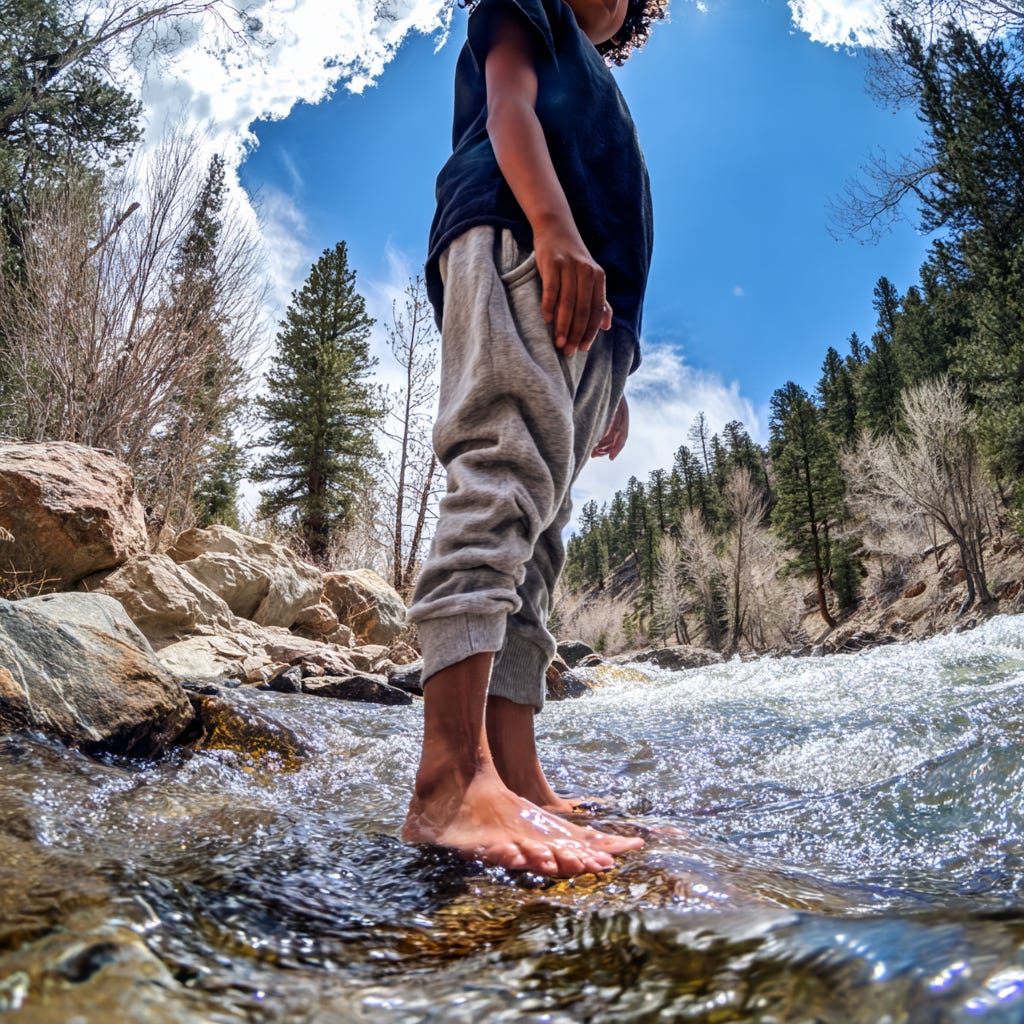
“We have outsourced our perception” - indeed!