AI & HUMANITY TRILOGY
Why this Trilogy Exists, and Why Embodied Truth Matters more Than Speed, Ease, or Memorization

On January 25th, 2026, I was invited by the Association for Performance Development (APD) Academy, to speak with their community on the theme “AI For You: What to Automate, and What to Keep Human.”
In preparation, I reviewed that materials used in Strategic Artificial Intelligence programs, and focused on the EVERY framework developed by AI for Education in collaboration with Vera Cubero. This work represents leadership foresight at a moment when much of the AI conversation has been hurried, reactive, and dominated by the language of acceleration. EVERY did not arrive casually. It reflects careful thinking, lived experience, and a serious attempt to restore human agency, ethical responsibility, and discernment to education and business systems engaging with AI.
The strength of EVERY lies not only in what it names, but in how it meets institutions where they are. The framework uses an acronym deliberately, drawing on a long-standing educational tradition of shared language and structured recall. In complex organizations, that matters. It creates coherence. It allows people to orient themselves ethically without being overwhelmed. It slows the conversation just enough to ask better questions while remaining usable inside real systems. That balance between humanity and practicality is not easy to achieve, and it deserves to be acknowledged.
As a response to the EVERY framework, and the theme of the panel, I reflected on how we could move the needle toward a more humane approach to AI use.
With this in mind, I offer you an AI & HUMANITY TRILOGY, a three-part progression of posters. They begin with governance, move through development, and ends with cultivation. If the final poster feels quieter, that is intentional.
The first poster highlights the original EVERY framework, and sits squarely in the present moment. It reflects where many organizations now find themselves, sometimes uncomfortably so. AI has been adopted quickly, often without sufficient context, governance, or senior-level wisdom embedded into its use. The result has not been neutrality, but amplification. AI mirrors the quality of the human systems it is trained within, revealing gaps in integrity, documentation, relationship, and care. The first poster speaks in a language systems already recognize, because that is often where meaningful change must begin.
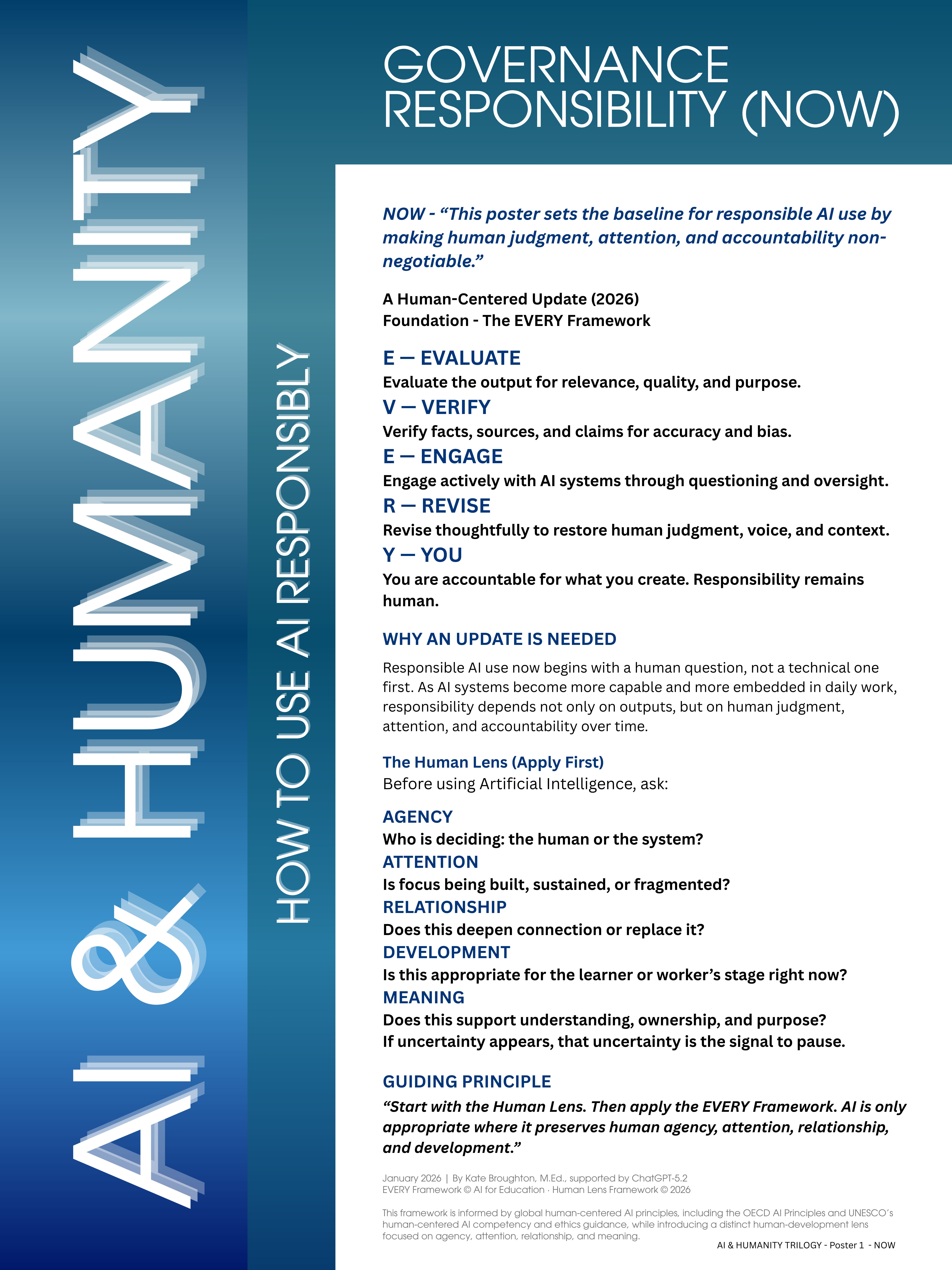
From there, the trilogy moves gently forward. The second poster turns toward the question of why this human-centred turn matters at all. Why agency, attention, relationship, development, and meaning are not optional values or cultural preferences, but foundational human capacities that erode when speed, ease, and memorization are mistaken for learning and wisdom. This is where the lens widens beyond organizations and into generations. Gen Z has already exposed the cost of systems that demand performance without meaning. Their fatigue, skepticism, and refusal are not failures of character, but signals of environments that have stretched human capacity too thin.
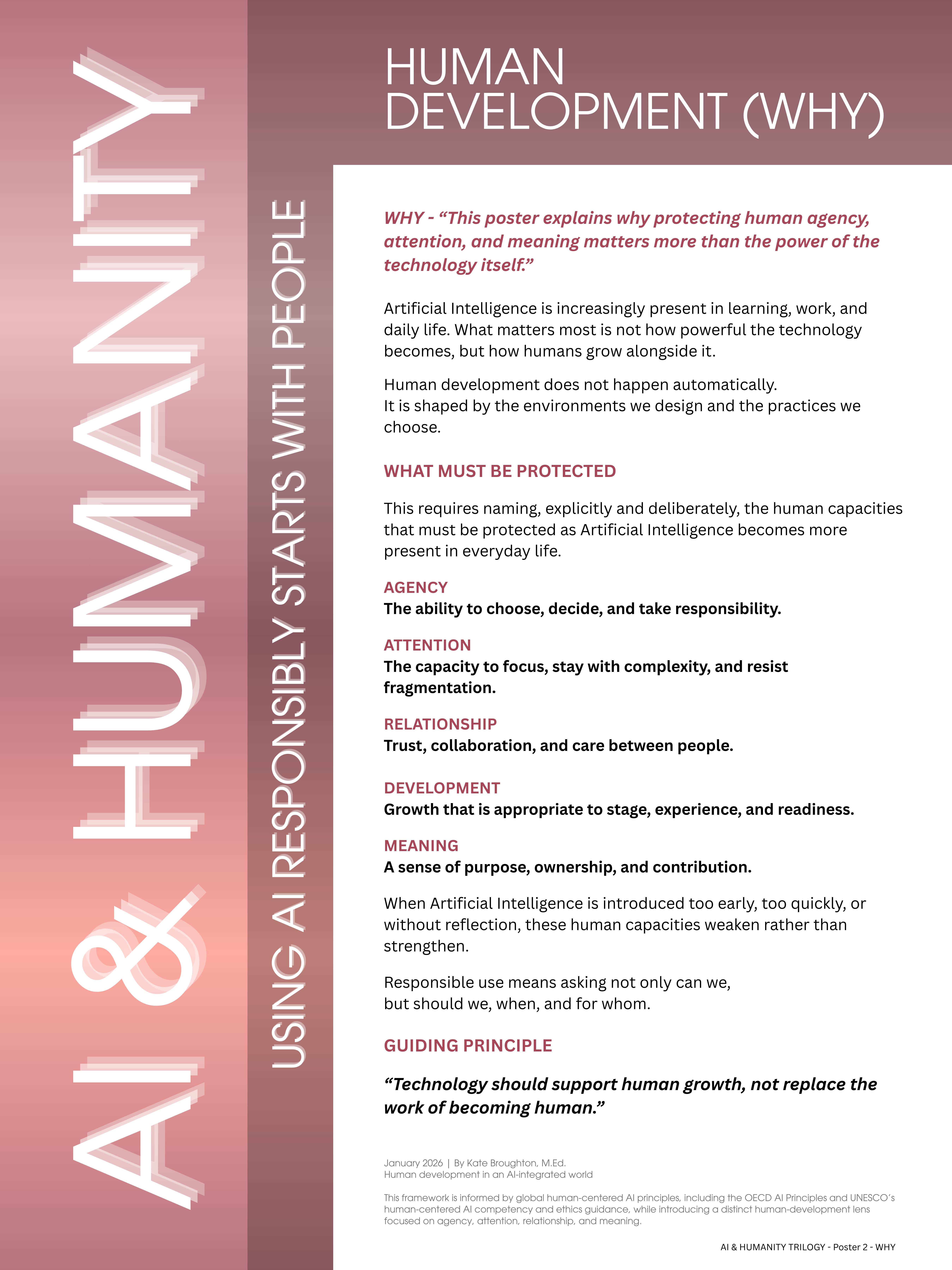
The third poster looks further still, toward Gen Alpha and beyond. Here, the structure changes intentionally. On second and third poster, the letters at the beginning of the words do not form acronyms. This is not an oversight. It is a deliberate step away from the educational habit of equating remembering with knowing. Attend. Judge. Relate. Grow. Care. These words are not prompts for recall. They are capacities to be cultivated. They are meant to resonate, to matter, to be lived.
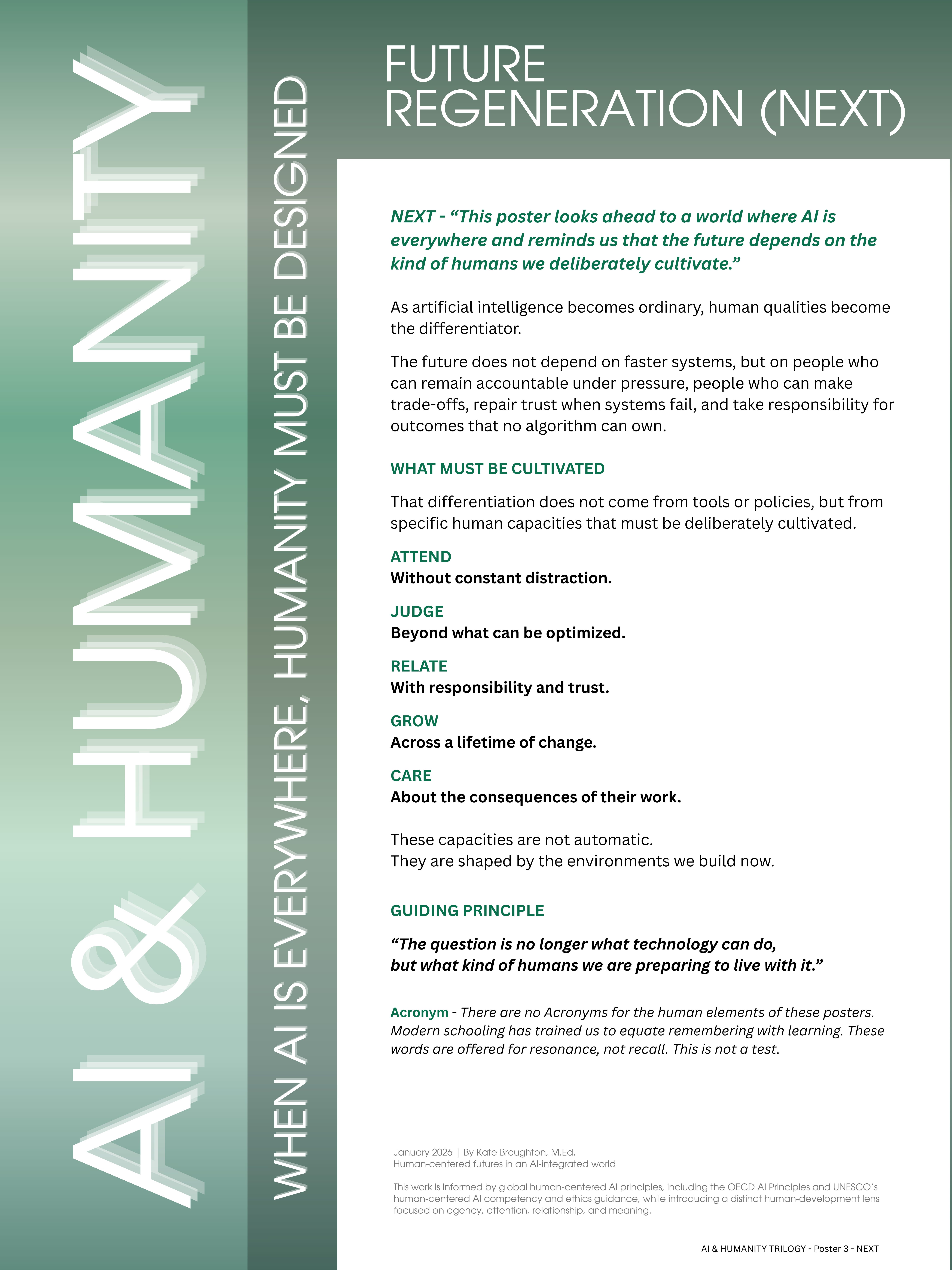
This is where the trilogy moves from systems into sensing, from performance into epistemology. How do we know that we know something? Not because we can retrieve it on demand, but because it settles in us. Because it changes how we move, how we decide, how we respond under pressure. There is a kind of knowing that is felt in the body, a quiet recognition that does not need to announce itself. A gut sense. A truth that brings coherence rather than urgency, rest rather than drive, safety rather than defence.
I am not claiming that what I have created is true in any absolute or universal sense. I am saying something more human and more modest. That we possess an innate capacity to sense what is real, what is aligned, what carries integrity. That this sensing has been steadily sidelined by systems that priorities speed, output, and memorization over meaning. And that artificial intelligence, by accelerating everything it touches, makes that loss impossible to ignore.
AI does not introduce new values. It amplifies existing ones. If our way of knowing is shallow, AI will magnify that shallowness. If our way of knowing is grounded, relational, and embodied, AI can be held within that steadiness. The trilogy exists to make that contrast visible without shouting, to offer a lens rather than a verdict.
Montessori understood this long before AI entered the conversation. Learning was never meant to be about memorizing abstractions detached from experience. It was meant to arise from deep engagement with reality, so that understanding becomes inseparable from the self. Observation, repetition, self-correction, relationship, time. These are not efficient processes. They are human ones. They cultivate integrity from the inside out.
This trilogy does not replace the work of EVERY. It stands beside it. It assumes its integrity and builds from its foundations. It begins in the language of systems because that language is still necessary. It then moves gently toward meaning, and finally toward embodied knowing, where no acronym is required because what matters has already been felt.
As AI becomes ordinary, the differentiator will not be technical sophistication alone. It will be the quality of the humans who design, deploy, and live alongside it. That quality cannot be downloaded, optimized, or recalled on demand. It has to be grown.
If these posters resonate, that is enough. They are not a test. They are not instructions. They are offered as a gentle progression, in the hope that we might remember how to know again, not with our memory alone, but with every fiber of our being.
If you wish to follow the research and thinking that inform this work, the books Mapping Montessori Materials for AI Competency Development and Montessori & AI -Volume I are available through my website, katebroughton.com.