Instant Soup
Impatient Living, the True Emotional Value of Slow

There is a law, Moore’s Law, that says technology gets faster and smaller exponentially over time. Recently I found myself wondering what the human version of that law might be. Not technologically, but emotionally, relationally, psychologically. What happens to human beings when more and more of life becomes immediate? When the distance between wanting something and receiving it gets smaller and smaller?
This question has been sitting quietly underneath daily life for a while now because increasingly everything feels designed around shortening the loop. You want something, it arrives tomorrow morning. You wonder something, the answer appears instantly. You think about contacting someone and your phone surfaces their name before you have even decided whether you actually wanted to call them. Artificial intelligence is increasingly moving into that territory too, helping us organize our schedules, answer our questions, recommend our purchases, summarize books, anticipate needs.
And none of this is entirely bad. Sometimes a can of soup is practical. Immediate. Available. Why so much of modern life leaves people exhausted enough to need everything compressed into convenience is probably another conversation for another time.
But lately the thought keeps returning through something very ordinary.
Soup.
I grew up with Campbell’s soup. The red and white cans that sat in cupboards across England and America and much of the Western world. The design was so recognizable that even now most people can picture it immediately without seeing it. Recently we bought flowers for a friend who had hurt her leg, and the vase itself was designed like a Campbell’s soup can. It said Get Well across the front. Immediately I was back in childhood, back to cold afternoons, quick lunches, opening cans in kitchens moving at the pace of ordinary modern life.
And the soup was good. Comforting. Reliable. Warm.
But instant soup was never really just about soup. It was about speed. About industrial life. About shortening the distance between hunger and satisfaction. Campbell’s became iconic partly because it solved a modern problem. Families were moving faster. Food production industrialized. Time itself became compressed. Soup became shelf stable, standardized, predictable, immediate.
Add water, heat, serve.
And there is nothing inherently wrong with that. Sometimes exhausted people need practical solutions. Sometimes opening a can of soup is itself an act of care at the end of a difficult day.
But everybody knows there is another kind of soup entirely.
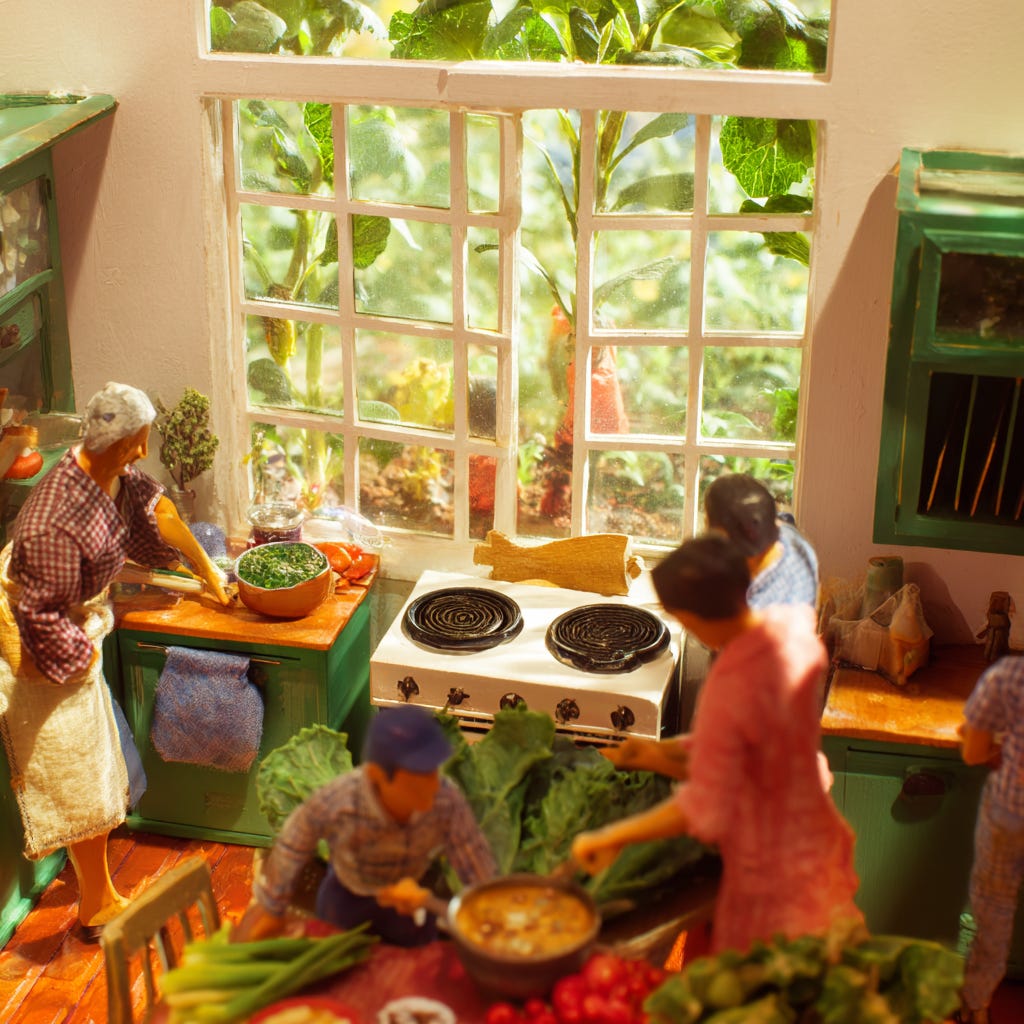
Something made slowly in a real kitchen. Chicken, celery, carrots, potatoes, green bell peppers, onion, garlic, diced tomatoes, parsley, salt, pepper, ditalini pasta. A Sicilian family soup simmering slowly on the stove somewhere while people move in and out of the kitchen talking, tasting, adjusting things as they go.
What makes that soup extraordinary is not only the ingredients. It is the life around it. The cutting board worn smooth over years. The smell of onions and garlic softening in olive oil long before anybody sits down to eat. The sound of pans and water and conversation. Vegetables grown in a particular soil. Recipes carried across generations. Children nearby, drifting in and out of the kitchen. Somebody singing absentmindedly while cooking. Fresh bread coming hot from the oven. A glass of wine halfway through the evening. Grief sitting at the table beside laughter because real families always contain both. The weather outside. The country itself somehow present invisibly inside the food.
The soup becomes inseparable from human presence.
And perhaps that is why Montessori environments so often feel different from modern schooling. Montessori, at its best, is education’s version of the family kitchen. Wherever you are in the world, Italy, Colorado, India, Australia, England, there is often a similar feeling underneath the environment. Warmth. Invitation. Gentleness. Real work unfolding beside real life.
Children move through spaces that feel lived in rather than industrialized. There are flowers on tables. Natural light. Wooden materials worn smooth by years of use. Quiet conversation. Somebody preparing snack. Bread baking. Soup warming. Vegetables from the school garden being washed by small hands at a sink. Tomatoes carried in still smelling faintly of soil and sunshine. Herbs clipped moments before lunch. Rain tapping softly against windows while children settle deeply into concentration without anyone rushing them toward the next thing.
The whole environment often feels less like a production system and more like human life unfolding at a pace the nervous system can actually absorb.
That pace matters.
Because increasingly modern life feels organized around the Campbell’s soup version of existence. Efficient. Immediate. Predictable. Optimized. Loops are shortened everywhere. Instant answers. Instant entertainment. Instant summaries. Instant reassurance. Instant communication. Instant delivery.
Slowly, almost invisibly, people begin reorganizing themselves around that pace without realizing what disappears when they do.
Because not every thought is a decision. Not every feeling is an instruction. Not every question needs an immediate answer. Human beings have always lived with pauses, uncertainties, unfinished feelings, passing curiosities, waiting. But increasingly we surround ourselves with systems designed to interpret every signal as something to complete. We feel uncertain, we distract ourselves immediately. We feel curious, we answer the question instantly. We feel desire, we satisfy it quickly.
And perhaps that constant immediacy quietly interrupts something deeper than attention.
It interrupts accumulation.
Memory accumulates slowly.
Trust accumulates slowly.
Attachment accumulates slowly.
Meaning accumulates slowly.
Children come to mind often in this conversation, particularly Montessori children, because Montessori environments still operate at a very different pace from much of the modern world. The work takes actual time there. Children repeat activities again and again until understanding slowly settles into the body. They color maps carefully. They count beads slowly. They read quietly in the mornings.
And if you walked into one of those classrooms and suggested speeding everything up, summarizing the books, optimizing the process, shortening the work, many of the children would genuinely wonder why you would want to. They are not trying to escape the process because the process itself matters to them.
I remember once in a Montessori classroom we found what looked like a dead praying mantis egg sac near the window. It sat there quietly for a while and then one day hundreds of tiny praying mantises emerged and covered the screen. The children carefully lifted them off one by one. It took time. Real time.
That moment still lingers because at one point it looked like a dry dead leaf, and then suddenly it was alive. But if the room had been organized entirely around efficiency and immediate outcomes, nobody might have noticed it at all.
Some forms of human understanding only emerge when life is slow enough for us to notice them.
A friendship deepens over time. Trust deepens over time. Children mature over time. Soup deepens over time. Even understanding something deeply often arrives quietly after repetition, after boredom, after observation, after returning to the same thing again and again.
Perhaps this is part of what is quietly disappearing as artificial intelligence and modern systems increasingly remove friction from daily life. Friction is treated as failure, inefficiency, something to eliminate. Yet some forms of friction may never have been problems to solve in the first place. They may have been part of how human beings developed patience, discernment, intimacy, concentration, imagination, satisfaction.
The pauses themselves may have mattered.
Because when people remember the food of childhood, they rarely remember efficiency. They remember kitchens. They remember smells. They remember who was there. They remember conversations, songs, weather, tables, tiredness, laughter, tears. They remember the feeling of life unfolding slowly enough for memory to attach itself to it.
Instant soup fills hunger. Slow soup feeds memory.
And perhaps much of modern life is becoming nutritionally full but emotionally undernourished. Loops have become so compressed that we risk removing the very conditions that allow meaning to accumulate around experience. A civilization organized entirely around immediacy may eventually struggle to remember how deep attachment forms at all.
The answer probably is not rejecting technology. The world is not moving backwards. But human beings may need places where not everything is accelerated, predicted, shortened, summarized, optimized, or instantly fulfilled. Places where thoughts remain thoughts for a while. Places where conversations wander long after the meal has ended. Places where children still experience long attention. Places where process matters. Places where soup still simmers slowly enough for the whole house to smell of it before anyone eats.
Because perhaps the future will not belong only to the people who move fastest through the loop.
Perhaps it will also belong to the people who still remember the emotional value of slow.
If you wish to follow the research and thinking that inform this work, the books Mapping Montessori Materials for AI Competency Development and Montessori & AI -Volume I are available through my website, katebroughton.com.
Image Prompt: Photo, HD, close-up inside a bustling Sicilian a kitchen with soup on the stove, family members are chatting at the kitchen table, children are playing, people are preparing vegetables (close-up) and someone is stirring the soup. The kitchen window opens onto a vegetable garden, light through the leaves of nearby trees glistens through the window.
If you are interest in the process of AI image generation, you night have some fun reading the prompt, and seeing how many things the AI got right, or not. AI image generation is improving fast, but it still gets confused.