Friction
The Beauty of Hard Things

Sometimes I think about how effortless life has become.
You step into the car, tap a small button that says Navigate Home, and suddenly a voice from nowhere knows the way more faithfully than you do. It is astonishing, really. I grew up folding paper maps and arguing with road signs, and now all I need is the existence of my face for the world to orient itself. We are living through this cultural drift toward ease, and it’s so subtle that you often don’t feel the shift until something reminds you what effort used to feel like.
I turned off facial recognition recently. I thought it would be nothing. A tiny inconvenience. But now every time I type in a code, something I used to do for years without noticing, I feel irritated. It is such a simple thing, the act of typing. But the friction of it, the tiny pause, the small return of thought, feels ancient in my hand. It made me realize how quickly I have become trained to expect the world to open up to me without effort. A door that opens before I touch it. A payment that processes before I think about money. A notification that anticipates a need before I articulate it.
Ease has become so normalized that any deviation feels like an insult. And I am not judging this, I am noticing it. Noticing how the nervous system adapts to the path of least resistance, how human cognition tends to conserve energy, how our hunger for convenience is patterned into biology. Researchers have written about this for decades, particularly in the field of cognitive load theory, research explaining how the brain is designed to find shortcuts, to reduce complexity, to preserve metabolic energy. Ease is not a modern invention; it is a neurological preference.
But ease is not always what makes us grow.
And this is the part I keep circling in my mind. What happens when everything becomes seamless? When frustration is treated as a design flaw? When confusion is seen as a bug, not a teacher? What happens to children, especially children, when the environment becomes so smooth that they never need to stretch their inner architecture to meet the world?
Psychologists like Robert Bjork call this “desirable difficulty.” A small amount of friction enhances learning, strengthens memory, and deepens understanding. Neuroscientists studying executive function tell us that persistence, working memory, and emotional regulation grow under conditions of moderate challenge. Not too much. Not overwhelming. But just enough to awaken the mind into effort.
This is what I keep feeling as I think about ease: friction is not the enemy of learning. Friction is the birthplace of competence. Friction is where we build the belief that we can.
And yet, so many children today have learned the opposite lesson. They have learned that difficulty is dangerous. Difficulty is embarrassing. Difficulty exposes you. Difficulty is where other people watch you fail. This is the accidental legacy of performative schooling, where difficulty is often paired with public evaluation, comparison, labels, and humiliation. Where mistakes are graded. Where effort is judged. Where confusion is a sign of deficiency instead of a sign of growth.
It is no wonder so many children give up quickly. They are not avoiding the task; they are avoiding the emotional cost of trying.
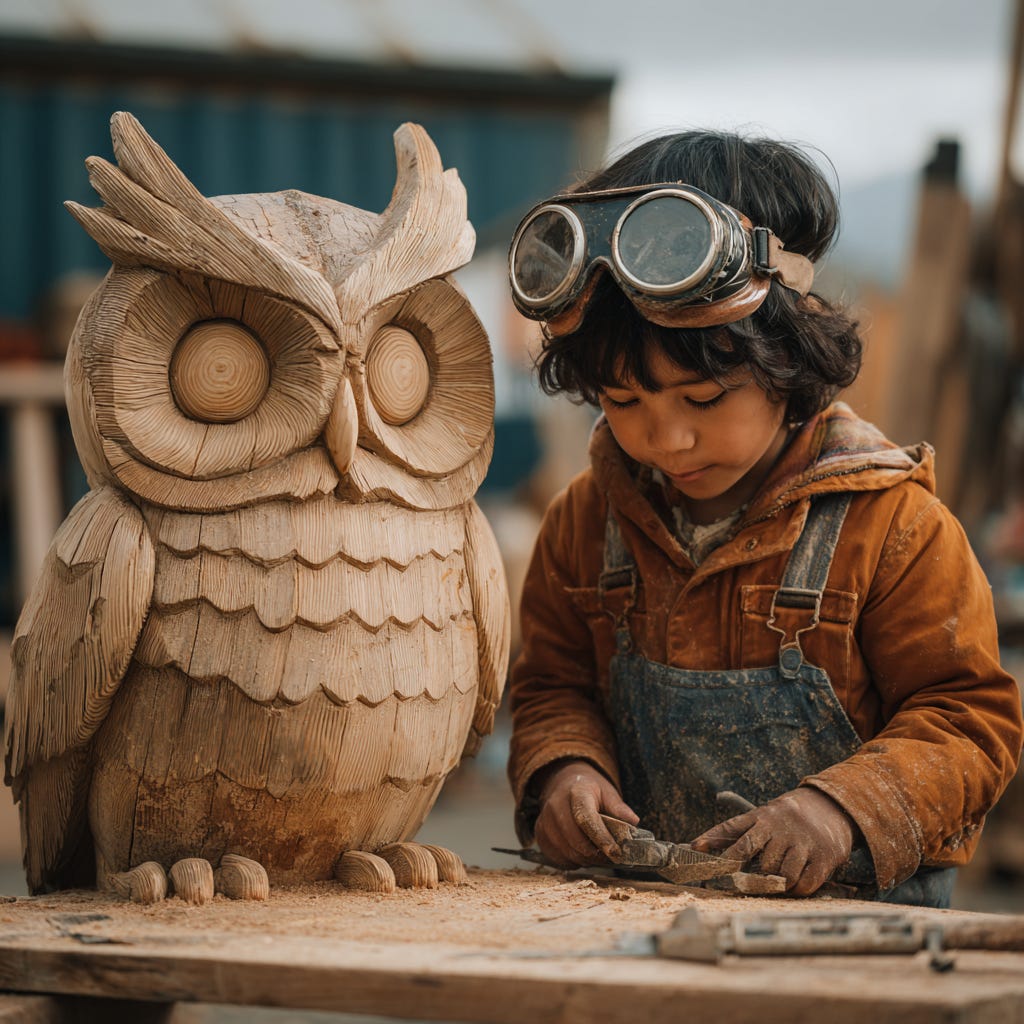
But this is not how development is meant to unfold. In Montessori we see a different reality. A child in a Montessori environment will often choose the hardest work in the room. They will repeat something again and again, not because anyone asks them to, but because mastery is pleasurable. This is the phenomenon Dr. Montessori called the “polarization of attention,” when a child enters deep concentration and discovers the joy of effort. The material itself provides the friction, the control of error, without humiliation. A cylinder that does not fit. A tower that collapses. A bead quantity that does not align. The child learns through feedback that is private, precise, and supportive.
They learn that difficulty is interesting.
They learn that effort is part of becoming.
Something precious happens when children are given meaningful friction that is safe, spacious, and self-directed. They develop what psychologists call intrinsic motivation, where the desire to continue arises from within. They seek out challenge not because the adult assigns it, but because the work aligns with an internal developmental need. Montessori observed this relentlessly: children voluntarily choose difficulty when they feel safe, autonomous, and purposeful.
It is so different from the world many children inhabit, a world where hedonic pleasure has become the primary emotional currency. Where comfort is the default expectation. Where frustration tolerance is shrinking. Where doing something that does not feel immediately satisfying is seen as a failure of the environment instead of a practice field for the human spirit. But developmental psychology is clear: pleasure is not the same as fulfillment. What we are meant for, what deepens us, what grows us into ourselves, is not pleasure alone, it is purpose.
And this is the missing question in most schools:
What is your purpose? What lights you up? What moves you? What problem in the world makes you feel something? Who are you becoming?
Children endure enormous frustration when they care. You see it in a child assembling a complex puzzle long after others have stopped. You see it in a ten-year-old building a timeline that takes hours. You see it in the adolescent managing a micro-economy, negotiating with peers, or completing a community project. You see it in every purposeful child who will work beyond their limits because the work matters.
We call this cosmic task, the idea that every child comes into the world carrying a thread of purpose that belongs to the evolution of humanity. When children sense this inwardly, they will push themselves in ways no adult could ever force. They will choose friction. They will tolerate confusion. They will move toward the outer edges of what they can do because something inside them is whispering forward.
This is why friction matters. Not the friction adults impose for the sake of rigor or performance. Not the friction that humiliates. Not the friction tied to grades or measurement. But the friction the child chooses because they have discovered who they are, what they love, what problems feel meaningful to them.
This is the great failure of performative schooling: children are asked to work hard without being given a reason. They are given difficulty without purpose. Tasks without identity. Effort without belonging. And so they withdraw. They pick the easy thing. They refuse challenge. They protect themselves from the emotional pain that the system has attached to difficulty.
And all the while, their nervous system grows smaller.
But we can reverse this. We can build environments where difficulty is safe, meaningful, and chosen. Where children feel the joy of deep effort. Where frustration is framed as an essential part of mastery. Where confusion is respected as the doorway to understanding. Where the adult stands back and allows the child to unfold.
Dr. Montessori knew this. She built an entire pedagogy around it. A pedagogy where autonomy, agency, concentration, purposeful work, emotional safety, and self-construction are not “nice extras,” but the foundation of learning from infancy upward. A pedagogy that shows the child, through lived experience, that friction is beautiful, effort is meaningful, and the becoming of oneself is worth every difficult attempt.
And maybe this is what the future requires: not more ease, but more meaning. Not more seamlessness, but more purpose. Not a frictionless world, but a world where friction is understood as the place where human beings grow strong.
I think about the last six months of book publishing, the endless mistakes, the steep learning curve, the corrections, the details I never knew existed. I felt frustrated so many times. But I also felt alive. I felt autonomous. I felt stretched. I felt proud. And I learned more than I ever expected because I had a purpose higher than the difficulty.
Children deserve that too.
A purpose worth growing for.
A problem worth solving.
A task worth their frustration.
A future worth their effort.
Friction is the beauty of hard things.
And hard things, chosen freely, held safely, guided by purpose, are where children become who they are meant to be.