Early Childhood Education
Creating Real Harm Without Understanding Child Development

I was listening to the radio and there was a piece about childcare, about making childcare a utility, something like the maintenance of roads or policing, a public good that society simply provides. The argument was not difficult to follow.
And my first thought was, yes, of course we can do that. But then the second thought arrived almost immediately after: we have to be very, very careful about what pedagogy we place inside those earliest classrooms.
There is a structure already available to us. Public schools could be extended to hold a zero to three, three to six, six to nine, nine to twelve grouping, the same structure that Montessori has used and refined for well over a century. That part is not complicated.
The complication is not organizational. It is pedagogical. And it arrives most urgently at the bottom of that structure, in the years before six.
The infant classroom is where this becomes most urgent and where the stakes are highest. When a baby is not yet mobile, the crib is one thing. But when a child is crawling, the floor bed in a Montessori infant environment means that when they are ready to go to work, they simply crawl off their bed and go toward what interests them. They are autonomous. They are choosing.
In many childcare settings, the crib sides remain in place long after the child is a crawler, not for developmental reasons but for practical ones. When an educator is managing several children alone, the crib creates a boundary that puts the adult in control of when that child is released into the room. Toys may be placed in the crib and that may be called playing.
But a crawler kept in a crib is a child whose gross motor development, whose whole early mastery of their own body and its movement through space, is being systematically withheld. That is not a minor thing.
When we make daycare or childcare into playgroup, we miss out on the earliest and most vital formative years, the years in which children are building every skill and capacity that will carry them forward. That period is not a waiting room. It is not simply being with other people or being kept safe and warm until real learning begins elsewhere. There is nothing superficial about what is happening in a child between birth and six. This is the period in which the adult they will become is being formed.
What is interesting, and worth saying clearly, is that the shifts required to do this well are not technically hard. The biggest shift is the ontology, the whole orientation and behaviour of the educator. After that, it is the set up of the room. Many playgroups already have shelves around the walls. That part is not so far away.
What is missing are the lessons. The understanding of how to set up a tray deliberately, how to present a single exercise, something like the impermanence box for a zero to three environment, or one piece of paper, one crayon, one stencil. That simplicity is not poverty. It is precision.
And beyond the materials, what is missing is the understanding that the children themselves must be taught, from the very beginning of the year, how to be in the environment.
Those early lessons take roughly a month. Walking feet, how to move through a classroom without disrupting the work of others, how to pull out a chair and push it back in quietly, how to roll a rug onto the floor and roll it up again, how to come to a snack and restore the space after it, how to sweep up crumbs, how to wash a plate.
The educator comes back later, when the children are at recess, and washes those plates and cups more thoroughly. But the children are in the habit of knowing that the care of the environment is part of their work. If something is spilled, they tidy it up. If crumbs are dropped, they sweep them up.
These are not peripheral courtesies. They are the curriculum of community. The educator reiterates them and reiterates them until every single child is demonstrating a full understanding of how to be within the environment and how to treat the people and materials inside it.
How do we behave in community, how do we behave in a group, how do we behave when we feel angry, how do we behave when we feel sad, how do we deal with frustration. So many things. The context of being in community and society, how we treat our materials, how we treat other people’s materials, other people’s possessions, other people’s bodies. That is a full exploration.
When something goes wrong, when there is pushing or rudeness or real distress, what matters in that moment is that the situation is dealt with completely. Not punished, not criticized, not judged, not isolated. The child is given tools.
Both children might sit down together on the main rug and share what was felt. What it felt like to be pushed. What was happening inside when the pushing happened. There are many ways to work through those lessons, and they come thick and fast at the beginning of the school year, especially where there are new children arriving into a class that already has older ones.
In the multi-age groupings of a Montessori toddler environment, those older children become mentors. They carry something of the understanding the younger ones are still building.
The contrast with a less considered environment is not subtle. Think of plastic toys on a shelf with no particular place they need to return to. Missing pieces on work that has been put back anyway. A pile of paper, a pile of crayons, a pile of scissors, and no sense that any one child needs to wait for anything or treat anything with particular care.
And that is its own lesson, though not one anyone intended to teach. When you put six of the same material on the shelf to account for everybody, children never learn how to wait for the material they want. The waiting, and the wanting, are part of what makes the material worth caring for.
The noise that comes from an unconsidered environment is not incidental. It reflects a whole relationship with materials and with space. In a Montessori classroom the materials are beautiful, often made of wood or glass or metal, and the children know it. They know that glass can break. That knowledge changes how they hold things. It changes how they move.
By the time the children are in the elementary years they have absorbed all of this so thoroughly that when they come to a piece of work and find a missing piece, they ring the small tingsha bell gently, and they say, I have come to this work and there is a missing piece. Does anybody know where this piece is? And sometimes another child says, Yes, it’s on the counter. I put it there earlier.
The classroom has become a community of people who take care of it together, because they have experienced what it means to live in a space that is ordered and findable and safe. That reliability settles the nervous system. It is genuinely reassuring, especially for the very young ones, to know what is on the shelf and where it is.
And by the end of that zero to three year, when the children move into the three to six classroom, they arrive already carrying something. They have been learning pre-language, pre-math, pre-geometry, all the things they will meet in the materials ahead of them, through experience and conversation and time outside. They do not have to relearn how to walk around a room. They already know how to pull out a chair quietly and push it back in. Everything is refined and reiterated every year, but the foundation was laid in those first years.
There is almost a catastrophic dimension to getting zero to six wrong. If we create a public childcare infrastructure and put inside it the ordinary assumptions of a standard public school system, we are not simply providing a neutral service. We are actively shaping the formation of children during the period when that formation is most consequential and most irreversible.
What is that period for? It is not just play. It is not just being with other people. It is not custodial. It is the vital formative period, and it requires pedagogy that understands what it is.
Making childcare a utility is probably a wonderful idea. But not if it is not thought through carefully. The pedagogy placed in those earliest classrooms, in the zero to three environments in particular, needs to come from somewhere serious.
In my mind, as always, it better be Montessori. Not Montessori-inspired, not Montessori-adjacent, not sort of like Montessori. The actual pedagogy, from high quality AMI and AMS training centers, from educators trained at those levels, who know how to set up those environments and train the people working inside them.
The architecture of public expansion is the easier part of this conversation. The harder part, and the part that must not be skipped, is understanding what we are doing when we place a very young child in a room and call that education.
If you wish to follow the research and thinking that inform this work, the books Mapping Montessori Materials for AI Competency Development and Montessori & AI -Volume I are available through my website, katebroughton.com.
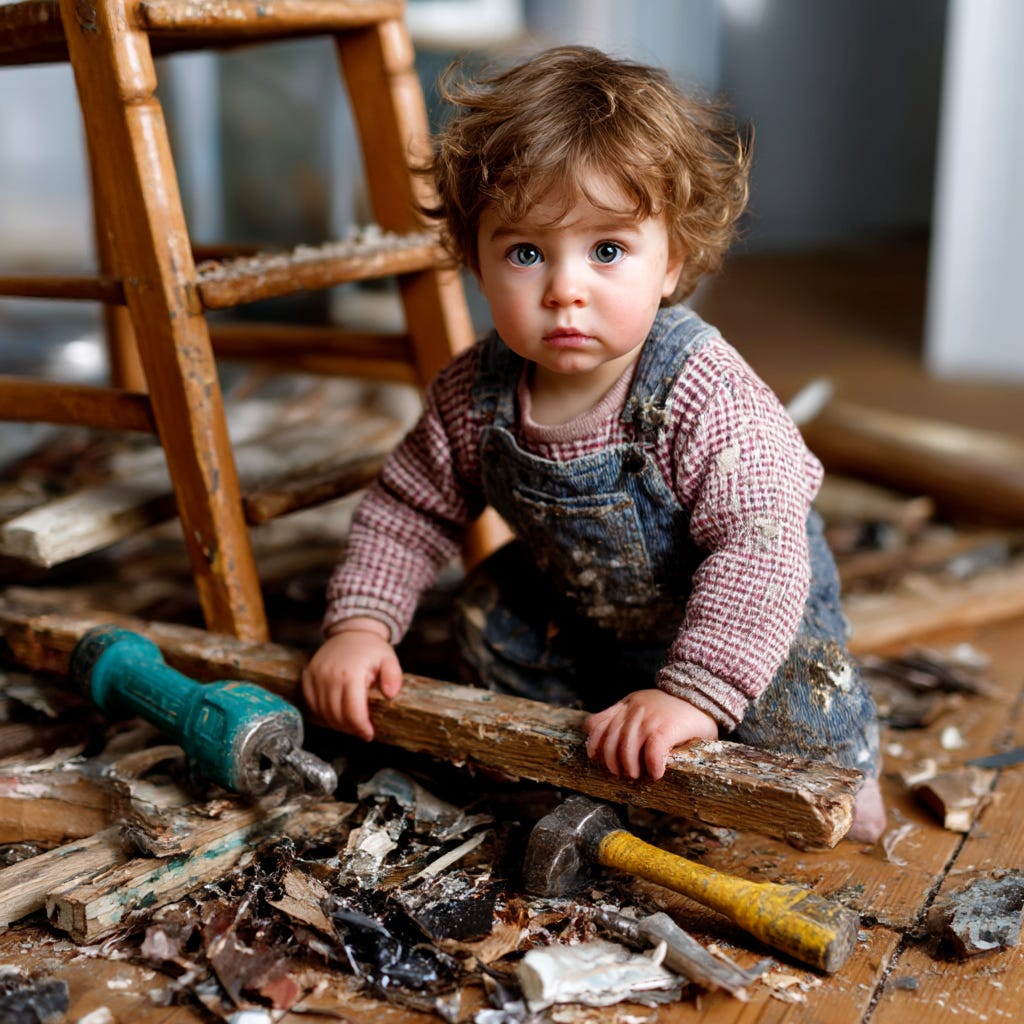
Image Prompt: Creating Real Harm Without Understanding Child Development.