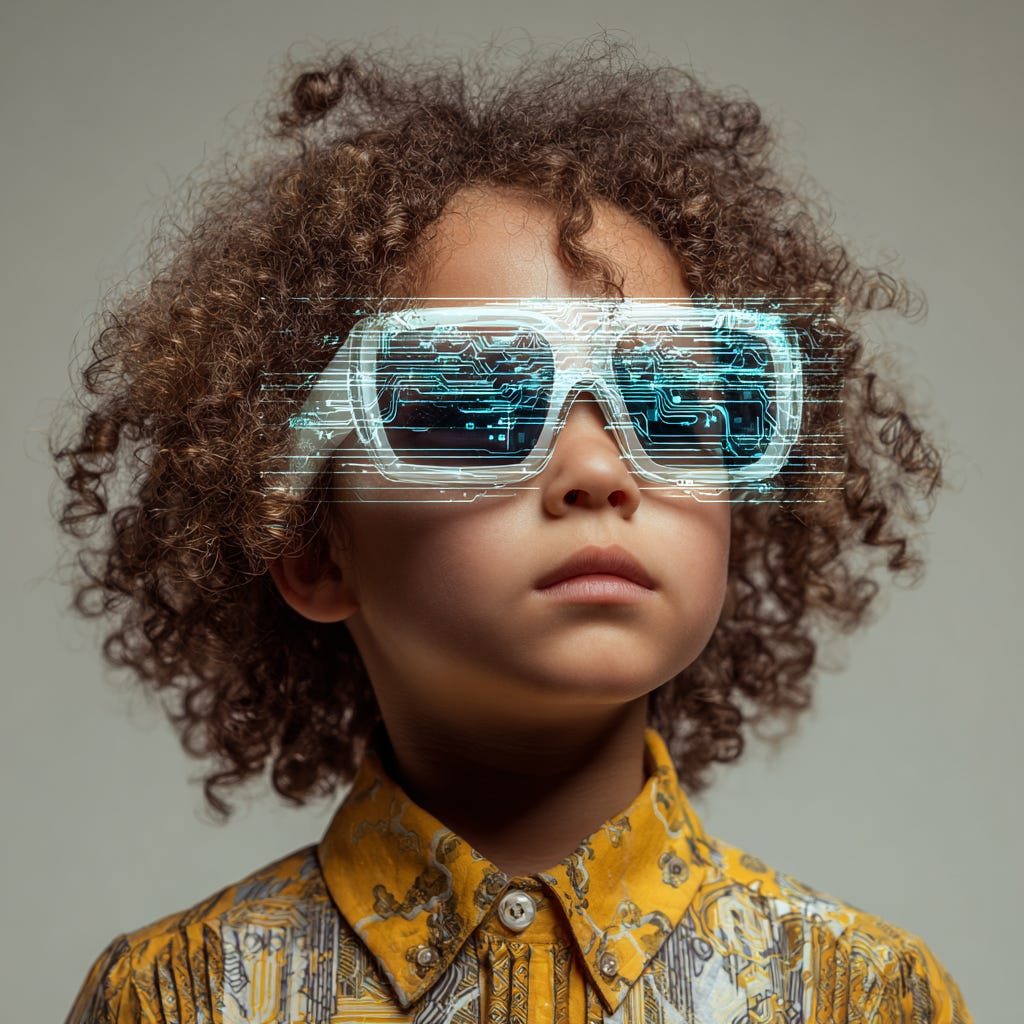
AI Glasses
Not So Transparent for the Child

Our eldest daughter grew up in the 1990s, sneaking her flip phone under the covers, whispering to friends until the small hours of the morning, then fighting sleep in lessons the next day.
At the time it felt like mischief, not a public health experiment. Only later did systematic reviews show that heavy screen use is strongly linked to shorter and poorer sleep in children and adolescents, with most studies finding delayed bedtimes and reduced sleep duration when devices enter the night-time routine. We did not mean to run a global trial on adolescent circadian rhythms. We simply did not yet understand what we were putting into their hands.
Now the device is not in the hand. It is on the face.
What we call AI glasses sit at the convergence of several mature technologies. Smart glasses already combine high-resolution cameras, microphones, displays integrated into lenses or frames, and constant connectivity. A decade of research on augmented reality smart glasses in education has explored how head-mounted displays can overlay text, diagrams, and prompts into the wearer’s visual field, changing how learners take in information and how teachers orchestrate the environment. In education, Smart glasses are already being considered, and in medicine, narrative reviews show that smart glasses can provide live procedural guidance and real-time feedback for students observing surgery or clinical skills, effectively turning the clinician’s gaze into a teaching channel.
On top of this hardware sits a new layer of software: deep learning for computer vision allows systems to recognize objects, scenes, text, and faces with astonishing reliability, while multimodal large language models link images, audio, and text into a single interpretive engine capable of captioning, translating, and explaining what the camera sees. Studies in education are already asking whether such multimodal models can reshape learning by providing on-demand feedback, hints, and context directly in the flow of activity.
The result is simple to describe and enormous in implication: a child can look at the world, and a non-human system can whisper what that world “means” in real time.
Montessori’s principle of whole to parts gives us a way to think about this. In cosmic education, the child is first offered the whole, the universe, the Earth, the sweep of life, and then invited to move into parts, details, disciplines, and personal contribution. The adult does not stand between the child and reality; rather, the adult prepares an environment that allows the child to encounter reality directly, with just enough support to orient and just enough freedom to explore. The child’s own attention, curiosity, and repetition are the instruments of learning.
AI glasses change the geometry of that encounter.
Instead of perception moving outward from the child toward the world, interpretation now moves inward from the system toward the child’s eye. The device can name any object on the shelf before the child chooses to touch it, translate any sign before the child feels lost, summarize any page before the child has struggled to decode it. What began as a cosmic invitation, “Come, see the world,” risks becoming a guided tour with a very talkative guide.
The stakes are high because this is not only about information. It is about agency. The literature on children’s agency in families, schools, and society describes children as active contributors to social life, whose sense of power and responsibility grows when they can initiate, choose, and influence events around them. Studies of identity development in adolescence show that a core developmental task is the construction of a coherent self-story, shaped by experiences of competence, belonging, and recognition. When a tool sits at the gateway of perception, continually offering labels, suggestions, and judgements, it does not only alter what the child knows. It alters how the child comes to see themself as a knower.
I think of children in today’s classrooms saying, “It is only a pair of glasses, Miss,” the way earlier generations said, “It is only my phone.” The teacher is already back-footed. Is the child listening, or quietly reading messages in the corner of their eye. Is the student researching the topic, or watching a stream of entertainment no adult can see. Early work on smart glasses in learning contexts suggests that even university students using them for seemingly ordinary tasks, reading, browsing, writing, describe a shift in how attention is distributed between the physical and digital layers of experience. For a developing child, that shift may be even more profound.
Around all of this sits a climate of comparison that did not appear from nowhere. The modern language for it is FOMO – the fear of missing out. A widely cited review describes FOMO as “a pervasive apprehension that others might be having rewarding experiences from which one is absent,” closely tied to social media use, lower mood, and lower life satisfaction. Fear of missing out has been conceptualized and measured in detail and is consistently associated with compulsive checking and difficulty disengaging from online streams. This fear is not a random quirk of the digital age. It is the emotional shadow of systems that constantly rank, compare, and broadcast who is ahead and who is behind.
Traditional schooling has often done something similar. Long before social media, children were lined up, graded, ranked, and told where they sat in the distribution. The one-size-fits-all timetable, the standardized test, the bell curve, all of these taught children to monitor where they stand rather than who they are. It is not difficult to see how this conditioning prepared the ground for digital FOMO. If your worth has always been measured against others, why would you not fear missing out on whatever might secure your place.
Into this landscape, AI glasses will not arrive neutrally. They will be marketed as advantages, a way to stay informed, stay efficient, stay ahead. There will be children whose parents buy them because they fear their child will fall behind if they do not. There will be others who long for them because classmates have them. The phenomenon that FOMO researchers describe, the anxiety of being left out of rewarding experiences, will easily attach itself to hardware that promises never to let you miss anything again.
We have already seen how this dynamic plays out with phones. Jonathan Haidt’s work on youth mental health and smartphones argues that the “great rewiring” of childhood since about 2010 is strongly associated with rising anxiety and depression, and he now calls for four norms: no smartphones before high school, no social media before sixteen, phone-free schools for the full day, and more unsupervised play. His coalition has created a phone-free schools action guide, and in the wake of his book The Anxious Generation, reporting suggests that over half of U.S. states now have some form of phone restriction or ban in schools, with similar moves emerging internationally. Early case studies show that schools adopting full-day bans report more eye contact, more playground play, fewer classroom disruptions, and a noticeable drop in the ambient hum of online drama.
It is not difficult to imagine the same debate repeating around AI glasses. Some schools will ban them on campus entirely, treating them like recording devices or concealed phones. Others, especially in well-resourced districts, may pilot them enthusiastically as tools for “personalized learning,” pointing to reports like RAND’s study of personalized learning models, which found some achievement gains but also raised concerns about narrow implementation and scalability. Critics will argue that layering real-time algorithmic feedback over every lesson risks turning classrooms into test beds where children’s gaze, responses, and micro-behaviors become data points.
From a Montessori perspective, the question under all of this is simpler: who is the primary agent of learning in the child’s life. If the answer remains “the child,” then any tool, including AI glasses, must be used in ways that protect and extend the child’s independent relationship with reality. That means periods of unmediated looking, touching, making, and moving, especially in the early years. It means environments rich in real materials, real conversations, and real consequences, where attention is trained through presence rather than through an external stream of prompts.
It also suggests that some families and schools will intentionally choose restraint. There will be parents who say no to AI glasses for their children, not out of technophobia but out of a desire to preserve an intact sensory and social world while the nervous system is still forming. The research on digital media, sleep, and mental health is already sobering; for example, systematic reviews find that greater screen exposure is consistently associated with shorter and poorer sleep among children and adolescents, and emerging work links heavy screen time and social media use to elevated risks of anxiety and depressive symptoms. Those who keep childhood anchored in offline reality, in play, craft, physical challenge, and real-world responsibility, may find that the “advantage” they appear to surrender in the short term becomes a different kind of advantage in early adulthood: grounded attention, stable identity, and the ability to be fully with another human being.
I do not think this will unfold as a simple split between “tech families” and “Luddite families.” It is more likely to be a spectrum of responses in which some communities treat AI glasses as normal, even necessary, accessories, while others quietly build cultures of device-light or device-free childhood. We are already seeing early versions of this: neighborhoods organizing phone-free play streets, schools implementing full-day phone bans, and parent groups coordinating to delay smartphone and social media adoption together so that no child feels singled out. The deeper question is whether similar covenants will emerge around head-mounted AI.
Three futures seem particularly visible from here.
In the first, AI glasses become invisible and ubiquitous. They are folded into everyday life the way smartphones were: first as novelty, then as necessity. Children wear them at school “for accessibility” and “for safety,” and over time the exception becomes the rule. Lessons are recorded, interactions are searchable, and the line between remembering and replaying blurs. Attention becomes a contested resource, split between the living moment and the constant possibility of looking something up.
In the second, AI glasses become a symbol of mistrust. Stories of misuse, covert recording, or manipulative data practices trigger a backlash. Certain spaces, schools, playgrounds, places of worship, community events, declare themselves “lens-free,” much as some spaces declared themselves phone-free. People begin to carry scanners or use visual cues to detect active devices. Glasses wearers are treated with suspicion, and the technology becomes associated with status, surveillance, or social awkwardness rather than with empowerment.
In the third, quieter future, AI glasses exist but do not dominate. They become tools used intentionally by adults and older adolescents for specific tasks, navigation, translation, specialized training, while childhood remains largely grounded in un-augmented reality. Schools adopt norms similar to those Haidt proposes for phones: no AI glasses in primary school, very limited use in adolescence, and strict boundaries around recording and data storage. Parents and educators align on a simple shared principle: the child’s developing attention is sacred, and any device that intermediates perception must be treated with the greatest care.
None of these futures is guaranteed. The difference between them will be made not by the glasses themselves, but by the stories we tell about what it means to be a child, a learner, and a human being in an age of ambient intelligence.
So I find myself returning to a kind of quiet, quantum attention question that underlies your work. If AI glasses are a new kind of mirror placed over the human eye, what pattern of seeing are they inviting us to normalize. If FOMO and old systems of ranking have already taught children to fear being left behind, what would it mean to design a culture that teaches them instead to feel at home where they are. If we insisted that AI serve attunement rather than optimization, helping us notice more deeply, relate more honestly, and protect time for real play and real rest, how might that reshape not only schooling, but the way an entire generation comes to see the world.
And perhaps the simplest question of all for parents and educators, the one a future historian of childhood might hope we asked in time: when a child looks out at the world, whose voice do we want them to hear first, the device, the adult, or their own.